Wednesday, June 22, 2005
A shared culture
Culture is an amazing thing. And it’s particularly amazing in Australia. Judy and I grew up roughly 2000 miles apart (Melbourne versus Cairns) and yet it was as if we grew up in the same town. We speak the same slang and have very similar recollections of our early years. The hymns she learnt and still loves from her Methodist church past overlap mightliy with the ones I love from my Presbyterian background. We are both total unbelievers now but it is still a great pleasure to reminisce by singing the old doxologies and hymns.
And I hope I share that delight with Protestants everywhere: Bunyan’s marvellous Pilgrim hymn (“Who would true valour see, let him come hither”); the great seaman’s hymn set to Sibelius’s “Finlandia: (“Eternal Father strong to save, whose arm hath bound the restless wave”); Blake’s incomparable British Israel hymn “Jerusalem” (Did those feet in ancient time walk upon England’s mountains green.. “); Rock of Ages, Be still my soul, and much more.
I hope everybody reading this knows what I am talking about. Anybody who has missed that great communion with our emotional past has been robbed of a mighty heritage.

Thursday, June 16, 2005
What we were
There are two stories (both true) that I like and sometimes tell:-
The first is from the autobiography of Robert Muldoon, National Party Prime Minister of New Zealand for many years. I liked Muldoon’s feisty character, which is why I bought his book. His policies were just Tory socialism, however. Anyway, there was a time during his Prime Ministership when Maori radicals were particularly unhappy with him (though many Maori gang members loved him) and there had been bomb threats made against him. So a police guard was mounted on Vogel House, where N.Z. Prime Ministers live. This being New Zealand, however, the police knocked off at 7pm and went home! So about 10 pm one night there was a knock on the door at Vogel house and there was nobody there to answer it but Muldoon and his family. So what did our Rob do? He answered the door personally! When he did so he found three big Maoris standing there. Were they there to assault him? What did they say? They said: “Rob, we saw your light on so we just dropped in to wish you goodnight.” They then all shook hands amid smiles all round and went off waving goodbye.
That story still makes me misty-eyed. It does show something of Muldoon’s guts but to me it mainly makes me mourn for the civil society we might have had and which New Zealand perhaps once was.
Another story in a similar vein is about England just after World War II. A Central European refugee had been given asylum in Britain but was in a category where he had to have some sort of residence permit which needed renewing from time to time. There came a time, however, when he inadvertently let his permit run out. So he got a visit from the local Bobby (policeman) early one morning. This of course struck terror into him. Under both the Nazi and Communist regimes he had known, having your papers out of order led to immediate jailing at the least. So a policeman was terminally dangerous. The conversation went something like:
BOBBY: “Mr X, I have come around because your permit to stay in Britain has expired.”
MR X: “I beg of you to forgive me. It must have slipped my mind.”
BOBBY: “That’s all right. I have to come by here on my way home tonight so give me your old permit and I will drop you in a new one on my way past tonight”. As the Bobby rode off on his bicycle, funny helmet and all, Mr X still could not believe his senses.
That story makes me misty-eyed too. How much we have lost! I doubt that such a thing would happen in modern-day Britain. In modern-day Britain (and Australia) we have “welfare” workers raiding homes to seize children from their parents on the basis of mere speculation. Truly abusive parents, however, are routinely allowed to keep control of their children. “Social Worker” and “Gestapo” seem to mean much the same thing nowadays. Evil, of course, normally needs to drape itself in the cloak of good intentions. Wise people judge the intentions by the behaviour, however: “Deeds, not words”. The desiccated old bags (mostly unmarried) who generally seem to run government Social Work activities one way or another are just arrogant and self-righteous Leftist busybodies who hate normal families. The young social workers who are their front-line troops are generally harmless enough, however. I have happy memories of two of them.
A final story that also tends to brings on the mistiness is one John Howard told in his victory speech in the 1996 Australian Federal Election. Howard said that like everyone else that day he had had to line up in order to cast his vote. (Casting a vote in Australia at the time did often require some patience. A 20 minute wait was not unknown, which is a lot by Australian standards). He found himself standing in a line behind a man whom he saw holding a Labor Party “How-to-Vote” card. The man turned around, saw the future Prime Minister standing behind him and said, “Hello. Nice to meet you. But I am still not going to vote for you”. John Howard then said on national TV that that incident typified for him what Australia is all about. I have to agree. In how many other countries would a future Prime Minister find himself in that humble and humbled position AND BE GLAD OF IT? It also showed John Howard as a sensitive and thinking man in being appreciative of the civil and yet “no nonsense” society we have here in Australia. He deserves his victories.
Sunday, June 5, 2005
“Society”, social climbing and the individual
I am in a reflective mood today so, being a psychologist, I thought the following brief reflection might be of interest:
Social climbing is widely condemned but quite a lot of people nonetheless seem to want to do it. If we understand what it is and why it is, it may help one to succeed at it but I think it also shows how pointless it usually is. I will use a little personal anecdote to set the scene:-
I once met in London a very nice young woman who was a minor member of the British aristocracy—the granddaughter of an Earl. I did not know that at the time and she did not tell me. Although my origins are proletarian Australian, we got on so well that she became my girlfriend. In other words, despite the “social” gap between us (which I was not even aware of), the other affinities between us still caused us to get on well and enjoy one-another’s company. That is the first lesson: It is the individual person that counts—not the group to which they belong. Finding people who are similar to oneself in outlook, attitudes and values is much valued but one may at times find such people in all sorts of places.
The second lesson stems from a time that the same lady introduced me to her uncle. He initially gave me that frozen reception which the British upper class give to anyone who is not one of “them”. I, however, just kept on contributing to the conversation in a relaxed manner and discussion of the events of the time immediately led to political issues. I expressed my political views without rancour but as plausibly as I could. (The once common advice that one should never discuss religion or politics is simply a confession that one is incapable of rational, moderate and amicable discussion of the events of the day). His views, not entirely accidentally, were similar to mine. More to the point, I was defending very plausibly causes that he believed in. He loved it! Now what do you think his attitude to me was by that time? Was it still frozen? Far from it. After knowing me for just 15 minutes, I honestly believe that he would have nominated me to his club if I had wanted it. The freezeout had totally vanished. I was now a “sensible young chap” or some such in his eyes. So the second lesson is similar to the first: Similar outlook, values etc. is the key to social “getting on”. Where two people have that, an awful lot of other differences can and will be overlooked: Not all differences, however. If I had had a Cockney accent, that would have been insurmountable! (The English tend to fudge their description of who a Cockney is so I should tell you that Cockneys are simply working-class Londoners—the most cheerful group of people I have ever met).
The fact that all people tend to group themselves socially, however, has as its concomitant that people are more likely to find others of similar attitudes and values within their own group. So my experience was somewhat unusual. But it does show that WORKING at social “advancement” will usually be pretty pointless. If you do not share the outlook and concerns of those you aspire to join, what is the point? Do you intend to conceal your real views and concerns and live a lie? Is that really how you want to live? If you do, one can only pity you.
By the way, what really is social “advancement”? Largely, it is a fiction. “Society”, as it is called is mostly an illusion fostered by certain middle-aged and aging matrons in order to give themselves a sense of importance. Among the British aristocracy there is some reality to it but elsewhere it consists simply of a small group of people who are united chiefly by a belief in their own importance—an importance that would not in general otherwise be obvious. Even among the British aristocracy, there are many groups and sub-groups and by far the most important thing there is which individuals you know and get on with.
Saturday, June 4, 2005
South African notes
I have never been one to keep a travel diary but I jotted down a few notes and reflections about my first trip to South Africa some years after the event and, given the notice that the world has taken of the place, I thought my notes and reflections might be of some interest to others. Here is what I wrote:-
I think it was in 1978 (during the Apartheid era) that I went to South Africa for 5 or 6 weeks. The University paid my way so I could do a survey there. Rather unoriginally, I was interested in surveying white attitudes to blacks etc. It was at that time an amazingly well-kept and affluent-looking place—at least in the white areas. Cheap black gardeners, I suppose.
The South African Indians were very interesting. They tended to live in big, opulent-looking houses and drive quality cars. Standing on the kerb in Johannesburg you saw dark men with European-type noses going past driving BMWs and the like. You also saw dark men with flat noses hanging out of dilapidated and overcrowded buses. The nose (race) seemed to make the difference. Apartheid discriminated roughly equally against all sorts of dark people but the Indians found the basically rather petty restrictions little problem (they did not, for instance, want to intermarry with the whites anyhow!) and were in fact at that time the richest Indian community in the world. They were averaging an income about 80% of the white average. So it was not Apartheid that explained negro poverty in South Africa. The sad fact of the matter is that Negroes are poor, violent and generally at the bottom of the heap wherever they live. And South Africa was the only part of Africa at that time where they did not from time to time have to face systematic mass-murder and famine. There was still a lot of sporadic black-on-black (tribal) violence and dire poverty among them but the South African border police were still there not for the purpose of keeping the South African blacks in but to keep foreign blacks out!
I took a drive through the notorious black township of Soweto with Leon Louw (a leading local libertarian). We needed no pass, suffered no restrictions and were even shown around by any government employees we approached. Blacks who saw us passing by waved. Most of Soweto comprises 4-room brick houses that are undoubtedly overcrowded but also seem solid enough. Water is laid on but I think they were just getting electricity (at the hands of WHITE electricians!). All Soweto houses had a yard of their own but I saw no greenery in any of them. As far as I could see, in Johannesburg it was only whites who were growing vegetables to save money! Isn’t that worthy of Ripley?
Incidentally, where does the name “Soweto” comes from? It sounds pretty African does it not? In fact it is simply an abbreviation for “South West Township”. Quite English, really!
I discovered some good foods in South Africa—particularly a type of curried Kebab called Sosaties. There was a mass-marketed Stout produced by S.A. Brewing that was very good too. The best I have tasted. And one of the Cape wines is unlike any other. It is a hybrid grape called Pinotage. It produces superb wines in South Africa but no-one else has much luck with it. Thanks to the moronic policy of several Australian governments it was for a time a prohibited import here. The best brand of South African wines seemed to be K.W.V. (translates to Co-Operative Wine-growers Union). All of black Africa drinks Cape wines when they can afford to.
White South Africans must at that time have been the most hospitable whites in the world. I know—from the doorknock surveying I have done. Only in South Africa was I regularly invited in when I knocked on people’s doors. They would answer my questions even if they were having Sunday dinner at the time.
After doing my door-knocking in Johannesburg, I took the train down to Bloemfontein. It was a slow steam-hauled train and rather took me back to my childhood train trips in Queensland. It was slow to minimize damage due to possible derailment (by black terrorists) and steam-hauled because there was at the time an embargo on supplying South Africa with oil. We passed a lot of shacks with blacks living in them on the way. It was notable that the corrugated iron roofs were always just held down with rocks rather than being fastened in any other way. When the train came by, the blacks would come out and wave to it. Lovely!
I stayed with Dr. Patrick Heaven (Yes, that really is his surname!) and his family in Bloemfontein and was amused when he introduced me to his fellow Afrikaner academics in the Psychology Department. They were all wearing ties! You would never see that anywhere else among psychology academics to my knowledge.
My trip to South Africa was in December so Patrick was kind enough to invite me to a family Christmas party when that came around. At the party a dear little Afrikaner girl (about 10) asked me: “And what do you think of our language?” I was delighted to be able to say (in complete sincerity): “I like the way you say “Dankie” (thank you)”. She seemed pleased with that.
Saturday, April 23, 2005
IN MEMORIAM: Sir Johannes Bjelke-Petersen (1911 - 2005)

The Honourable Sir Johannes Bjelke-Petersen, KCMG
I think all my Australian readers will know who "Joh" was but I would be surprised if any of my American readers do. Joh was for nearly 20 years Premier of my home State of Queensland. An Australian Premier is much more powerful than an American State Governor because he controls both the legislature and the administration. Australia seems to get on perfectly well without the American docrine of the separation of powers and, in a famous remark, Joh once revealed that he did not even know what the separation of powers referred to.
Joh led the National Party -- of which I was a member -- and was pro-business to a fault. As a result, Queensland saw an unprecedented rise in prosperity under his rule. During his time in office, Brisbane (the Queensland State capital) seemed to make the national news as often as Canberra (the national capital) because of Joh's total disregard for all Leftist pieties. In 1974, he gained a remarkable 59% of the popular vote. He was a great Queenslander and I miss him.
There are obits of him here and here. I have a previous comment on him here
Thursday, April 7, 2005
WHY I AM A LIBERTARIAN CONSERVATIVE
I normally mention my own political outlook only in passing. I am more interested in understanding what is happening in the world about me than I am in proposing my own grand theories. And in that respect I think I am a mainstream conservative. Conservatives don't like grand theories. I do however find libertarian ideas a very useful framework for thinking about problems. I think that most of society's problems are caused by governments usurping choices that could better be made by individuals and that government is just about the worst way of doing almost anything. So libertarians normally have a good answer to most social problems -- allow more freedom for individual choice. Libertarians have ideas and concrete proposals with a clear rationale and persuasive precedents. And that is a great contrast with the dismal Leftist reflex of solving everything via ever more pervasive coercion. And libertarian proposals in most spheres are normally congenial to conservatives too.
Where libertarians normally part company with conservatives is over moral issues. Conservatives want less regulation than Leftists but they do want some regulation. Exposing part of a black woman's breast at a major sporting event upsets some conservatives dreadfully, for instance. I am afraid that I remain a total libertarian on such issues. What people do with their own bodies seems to me to be supremely their business. And all arguments that some idea or claim should not be uttered or made known simply suggest to me that the idea or claim concerned is a powerful one that cannot easily be opposed. I would not go so far as to say that any censored idea or claim is automatically correct but I think there is a strong presumption in that direction. So the argument that sexual restraint should be fostered by censorship of sexual expression suggests to me that the arguments in favour of sexual restraint are weak.
Where I part company with many libertarians is that I find them too doctrinaire. I DON'T believe that there is one simple recipe that solves all problems. That to me is a Leftist outlook. As conservatives generally do, I see the world as infinitely complex and as not reducible to any simple rule. And in fact many libertarians agree with that. The extreme form of libertarianism is anarcho-capitalism -- the idea that NO government is needed for any purpose. I know all the arguments in favour of that view but see them as contrary to all human experience. Man is a social animal who has always throughout history felt at least some need for a government to perform certain tasks and I am perfectly confident that that will always be so. So as far as I can tell, most libertarians are not anarcho-capitalists. They are Minimal Statists. They believe that there are certain functions (such as defence) for which a government is needed. I am one of those.
So the distinction between Minimal Statists and Conservatives is one of degree. Conservatives have always wanted to limit the size and power of the State (I document 1500 years of history to that effect here) but they still want a much bigger State than Minimal Statists do. And I am a pretty minimal Minimal Statist. I think the USA could abolish its whole alphabet soup of government agencies (FDA, EPA, DEA etc) to great net advantage (for instance).
Where I appear to be in a minority among libertarians, however, is over the issue of immigration control. I am in favour of control. I am far from totally alone in that view among libertarians but I think it is pretty clear that a majority of libertarians believe in open borders. I think that is naive. Not all people are equally compatible with one-another and if a householder has a right to say whom he will welcome into his house then I think nations have an equal right to say whom they will welcome into their nation. Fortunately, I live in one of the few advanced countries in the world (Australia) that does effectively control its immigration. And my views on that matter make me very much a mainstream Australian. A huge majority of Australians agree with our government's policy of control.
Another way in which I depart from most libertarians but am very much in harmony with conservative traditions is that I do believe us all to be limited in various ways by human nature. Libertarians have no obvious place in their thought for the concept. They know it is a factor but see it as simply one of the many mysterious factors that determine people's preferences. For them only the preferences matter. What determines those preferences is for them unimportant. But conservatives think human nature is VERY important. They think it greatly limits what we do and can do and use it to explain WHY collective action is to be avoided where possible. They give reasons for preferring liberty, instead of simply asserting the desirability of liberty, as libertarians usually do.
That is not to say that libertarians have the same view of human nature that Leftists do. Leftists normally insist that human nature does not exist and that therefore any human being can in theory become anything he wants to be or can be "educated" into being. Libertarians, by contrast, are simply uninterested in whether that is true or not. Leftists think little boys can be "educated" into preferring dolls to trucks as playthings whereas conservatives think they cannot. A libertarian, by contrast, simply says that little boys should be given a choice of what to play with and who cares what they choose. Unfortunately, however, a lot of people do care so the conservative argument does have to be made. I personally agree with the libertarian policy in the matter but I think that policy does normally have to be backed up with conservative arguments about human nature to get it implemented.
Conservatives also have to make more of an issue of individual differences than libertarians do. That people are different and should be allowed to make different choices is axiomatic to libertarians but they normally take that as given rather than arguing for it. With their perennial "all men are equal" doctrine, however, Leftists are always trying to deny or minimize individual differences. Conservatives believe that doctrine to be disastrously wrong and argue vigorously against it. Conservatives believe, for instance, that some people work harder and smarter and therefore rightly get more money for what they do. Leftists however think (or claim to think) that all men are equal so unequal rewards must be unfair and the work of a flawed system. So whether or not individual differences are important is a major Left/Right issue -- but libertarians simply assume it away without debate. I spent most of my academic career researching individual differences so I am obviously in the conservative camp there.
And one way in which I differ from almost everybody these days is that I say out loud that there are some differences between the major races and nations of mankind and that some (but only some) of those differences are important. Up until the middle of the 20th century just about everybody believed that but the fact that Hitler used arguments of that general sort in justifying his deeds has made such arguments generally unmentionable in the modern world. I am however a psychometrician by trade. My expertise is in measuring psychological differences between people. I have had over 200 papers published in the academic journals reporting research in that connection. And perhaps the most solidly proven and replicated finding in psychometrics -- a finding that has always emerged in around a century of research -- is that people of African ultimate origin do have much lower average scores on general problem-solving ability (IQ) than do people of European ancestry and that variations in IQ are largely genetic. So, knowing what I know from my own field of expertise, I HAVE to say that the Leftist approach of treating blacks and whites as intellectually equal is doomed to failure. Somebody has got to say that the emperor has no clothes and I am prepared to be that person when required. Most people seem to think that makes me a "Right-wing extremist" or a "white supremacist". I think it simply makes me an honest scientist.
Monday, February 28, 2005
The magic of monarchy
I guess Americans will never understand it but there is something very basic in the human psyche that responds to monarchy. And Europe’s monarchies are some of the world’s most civilized and stable places. Because of its still-close ties with Britain (over a million out of 20 million of Australia’s current population were born in Britain), Australia is a monarchy and I am myself a strong supporter of the monarchy. A few years ago Australia had a constitutional referendum in which there was a strong case made for converting Australia to a republic but the Australian people gave that a decisive thumbs-down —two thirds voted to keep the Queen as our head of State.
Recently, Australians got another dose of Royalty-fever. A Sydney girl met the Danish Crown Prince in a bar and subsequently married him. So she is now a real-life Princess—of Denmark. The following news report just in tells a bit more about how strong a grip Royalty still has on people’s thoughts and feelings here in Australia. Even those who advocated a Republic at our referendum now are falling over themselves just to be in the presence of Princess Mary.
“The allure of rubbing shoulders with royalty was too much to resist even for some of Sydney’s best-know republicans yesterday as the city’s great and good turned out for lunch with Danish Crown Princess Mary and her husband, Prince Frederik. Republican NSW Premier Bob Carr played host as Princess Mary and Prince Frederik sat at the same table as Gough and Margaret Whitlam - both firm republicans. The 140 hand-picked guests at the lunch at Sydney’s Governor Macquarie Tower also included Sydney’s republican archbishop, George Pell. Mr Carr told guests it was not surprising the 33-year-old princess had married into a royal family, given her home state’s support for the monarchy at the 1999 republic referendum”.
Full story here
Sunday, January 9, 2005
Useful books
I have crazy interests for an atheist so I thought I might list the books I keep within arm's reach on my desk while I am blogging:
Strong's Exhaustive Concordance to the Bible; The Penguin Australian encyclopaedia; The Treasury of Scripture Knowledge; The Macquarie [Australian] Dictionary; Brewer's Politics; The King James Bible; an Italian/English dictionary; a French/English dictionary; a Spanish/English dictionary; a German/English dictionary; The Koran; The American State papers including the Federalist; an American desk encyclopedia; Pears Cyclopaedia; a dictionary of American slang; the poems and songs of Robert Burns; Mein Kampf; a Greek New Testament and the Anglican Book of Common Prayer with Hymns Ancient and Modern.
So now you know what I think I often need to know more about!
Monday, December 27, 2004
CHRISTMAS DAY FOLLOW-UP
My comments about my Christmas day generated a few comments of interest. There was some skepticism about my comment that the Scots "loathe" the English. I guess that was too strong a term. How about "profound suspicion" of the English instead? I first went to Scotland accompanied by a Scottish wife so I saw one side of Scotland that way. I also personally did a randomized doorknock survey in Glasgow for publication in the academic journals -- and several journals did in fact publish the results. So I got another view of Scotland that way: A community-wide view. So I saw Scottish people both intensively and extensively, as it were. So I do have some grounds for saying what I do. But one experience I repeatedly had is one that many Australians report: Scots cannot tell the difference between an educated Australian accent (or to some extent any Australian accent) and a Southeastern English accent. So Scots normally assume that an Australian visitor is English -- I was told on several occasions that I "sounded like the TV". And so they usually give the visitor the frozenly polite treatment that they reserve for the English. It is that treatment which causes the English to come to the remarkably false conclusion that the emotional Scots are "dour". When the Scots learn that you are Australian rather than English, however, they are greatly relieved, the frozen mask drops immediately and you are given a thoroughly Scots sentimental welcome. It is a joy to experience and sad that the English never do experience it.
Some readers also doubted that the Scots see the English as oppressors. The Scots certainly shouldn't and perhaps in their objective moments they don't, but one must not forget that Celtic memories are long and I can assure you that the execution of Mary Queen of Scots by Elizabeth I is still a lively memory in Scotland. So perhaps "oppressors" is a bit strong too but again I think "profound suspicion" does a pretty good job of characterizing the Scots attitude to the English. The Scots certainly see Australians in a much more positive light than that.
The famous Celtic memories are a big part of Scottish attitudes. The hugely popular song below was quite recently written but concerns a battle with the English of around 700 years ago. To a degree, the English are still the enemy of the Scots
One reader also commented that the pervasive Leftism of Scotland is a fairly recent phenomenon. That could well be true, though I have some reason to doubt it, but in any case I did explicitly say that I thought the Leftism concerned was "not genetic" -- which means that it could change with circumstances.
There was also some dissatisfaction that I did not criticize the multicultural emphasis of the Queen's Christmas message. I did not do so because I think the Queen was being perfectly realistic in her approach. The English egg has now been thoroughly scrambled and the dark-skinned population is not going to go away. So what the Queen was very strongly saying was that each group should honour both its own traditions and the traditions of others. And that way the different groups could live together without friction. What the multiculti Leftists want, on the other hand, is for the tolerance to be all one way. At the very least they want Anglo-Saxons to be tolerant while Muslims can be as intolerant as they like and it would be better still for Anglo-Saxons to lose their own traditions, customs and identity altogether. The Queen, by contrast, was saying that EVERYONE should be tolerant and that EVERYONE should honour their own traditions. And I agree in seeing that as the only viable solution for community harmony in modern Britain. No doubt there are more than a few people in Britain who would like to kick all the darkies out but that is not going to happen.
I suppose one could argue that the Queen could have stressed assimilation more but, on the other hand, the ethnic community members she showed did seem, as far as one could tell, to be highly assimilated. Assimilation does not imply uniformity -- just a familiarity with and respect for the ways of the majority community.
Sunday, December 26, 2004
MY CHRISTMAS DAY
As I always do, I attended a large family gathering on Christmas morning -- with "family" being very loosely defined. It is however essentially the same gathering I have been attending for many years. And, like most Australian Christmas gatherings, it is totally secular -- with no religious allusions at all. All the people there are however very good-hearted unbelievers. They even laugh at my jokes, so what more can I ask?
A small sadness for me was that, out of the 17 people present, there were only two children and one teenager. What used to be a very child-centered gathering still is a child-centred gathering but most of the "children" have now grown up and are young adults. No doubt the young adults concerned will one day have children of their own but the longer they leave parenthood, the fewer children they will eventually have, of course. So my family occasion did in a very small way encapsulate a problem that the whole of Western civilization is having -- too few children to replace itself.
I was delighted to see that one of the presents received by the small boy present was a pictorial "Encyclopedia of modern military aircraft" -- something that almost any boy would enjoy but which is of course totally politically incorrect. But the boy's father is a former Royal Air Force man so no doubt he too would be incorrect to the unhappy minds of the Left.
We had a "secret Santa" session before the "real" presents were given out and it was a really fun thing to do, with lots of laughs. I ended up with a "crumb sweeper" -- a small ceramic pig made in China that had a tiny electric motor in that turned it into a mini-vacuum-cleaner. I promised to take it with me next time I go to a Chinese restaurant -- to suck up straying grains of rice!
One of my stepdaughters spent a year in the U.K. recently, most of it in Scotland, and I asked her over breakfast what she thought of the Scots. "Loved them. Lovely people", she said. "But they were glad I was Australian". I too have great affection for the Scots. I even married one once. But Australians probably see the Scots in their best light. The Scots still loathe the English and they see Australians as fellow-sufferers from English oppression! Rather mad, really. But there is a definite streak of craziness in the Scots -- not the least of which is their intensely socialist outlook. But Scots outside Scotland seem to be heavily conservative -- as we know from America's Scots-Irish population (See also here). So it doesn't seem to be genetic. I once did some survey research on the Scottish difference which is reported here.
The weather was normal Australian Christmas weather -- hot and humid. So the various Bing Crosby Christmas songs that were being played in the background ("Jingle Bells" etc.) were referring to a different world. It did however show that culture trumps climate. I did of course eat too much but I think I will draw a discreet curtain over that.
In the evening, I watched the Queen's Christmas message on TV, as I usually do.
Every Christmas day the Queen broadcasts a short message to Britain and the other Commonwealth countries and it is always a positive message stressing important basics. She started out this time by stressing that Christmas is a Christian holiday so according to the politically correct brigade she was being most offensive to millions of people. In the British sphere of influence, however, what the Queen does and says is proper by definition so she does not have to worry about petty would-be dictators. Her message also stressed the importance of Britain's different ethnic communities living peacefully together and there were lots of shots of her and her family talking to British subjects of Indian origin. I have always liked Indians and got on well with them so I was delighted to see her extending such acceptance to them.
Friday, December 24, 2004
Merry Christmas!
To all those who come by here on this great day
And may all those who recognize Jesus as Lord always walk in his wisdom
Being a born pedagogue, I can’t resist this occasion to offer a tiny bit of seasonal information: I realized only recently that many people do not understand why “Xmas” is sometimes used as a short form of “Christmas”. Rather alarmingly, some people even seem to think that it is yet another attempt to take Christ out of Christmas. It is anything but. It in fact harks back to the earliest Christian times. The original New Testament documents were of course all written in the Greek language of the day and the name “Christos” (Christ) in Greek begins with the letter “Chi”. And the Greek letter Chi looks just like a big Latin “X”. So X is in fact the earliest symbol of the holy name and it was widely used as such by the early Christians of the Roman empire. So “Xmas” can in fact be seen as an acknowledgment of the early Christians.
Thursday, December 16, 2004
The Army and the Japanese
This is pretty disgusting. Young Japanese women living in Paris get so shocked by constant French rudeness towards them that some of them end up hospitalized with depression. I am sure my own manners are a bit rough at times but I always try to treat the invariably polite people of Asia with the courtesy that such politeness deserves. But like all elitists, the French think everyone else is scum, particularly Americans of course.
Because I am an accommodation provider and find Asians to be good tenants, I have met more than a few of the young treasures of Japan over the years and there is no way they deserve to be driven into hospital by foul treatment. Partly because I am a former Army man myself, I have met and talked to many “old Diggers” (Australian Army veterans) from WWII over the years and I share their disgust about what “the Nips” did to prisoners and others in that war. To this day, many of them would not consider buying a Japanese car. But because of their experiences, if nothing else, those men are true gentlemen and I can guarantee you that not one of them would be rude to a young woman just because she was Japanese. But ethics have always been something of an afterthought to the French from what I can see.
While I am thinking of the Army, I also want to record my disgust at the way Leftists commonly disparage the armed forces. To me the profession of arms is the noblest profession there is. Who else volunteers to lay down his life for his fellow-citizens?
And to revert to the Japanese: Lots of armies speak of fighting to the death but in modern times only the Japanese have done so.
Saturday, December 11, 2004
MERRY XMAS! 2004
MERRY XMAS! 2004
Below is the letter I sent out with my Christmas cards in 2004
Not a lot of news to report this year. My blogging keeps me busy in front of my computer for about 12 hours a day so I have become more sedentary than ever, if that is possible. I certainly go out very little these days except for frequent excursions to local eateries. Neither Judith nor I are keen on cooking so someone has to feed us.
Judith Middleton has now been living with me for some time. I am not sure what she sees in me but it is certainly not good looks. She is a geriatric nurse by occupation so that must make her feel at home with a moth-eaten old curmudgeon like me. She says that if I sat down to dinner with the residents at the nursing home where she works, no-one would notice anything out of place. She is a very kind-hearted soul so that when the more friendless residents of her nursing home go into hospital, she sometimes goes to visit them in hospital in her own time. It probably needs someone that kind to put up with me.
A small miracle
I am constantly in and out of surgery for my skin cancers these days. I just had three lots done at once yesterday. Rather remarkably, all the local anaesthetic the dermo pumped into me seems to have had a lasting but beneficial side-effect: For the last 4 months or so I have had a very sore left shoulder that I could move only in certain ways without pain. I never could work out for sure where the pain came from but it seemed to be tendonitis rather than arthritis. Anyway, six hours after surgery on my OTHER arm, the pain was all gone and I could move both arms any way I liked! I only hope the effect lasts! They put a lot of adrenaline into local anaesthetic so maybe that had something to do with it. Frozen shoulders are a rather common problem among oldies so now you know how to cure it! There are not many instant cures around for anything these days so it may be worth remembering. There was a famous case in America where some sort of surgical anaesthesia cured a kid of his autism so there may be more in these anaesthetics than meets the eye.
Joe
My son Joe is now 17, six foot tall, blue-eyed and blond-haired and definitely a young man.

He seems to have inherited my jocularity too. He did a university course in maths this year even though he was still in his final year at High School and got a Distinction (6 out of 7) in it so the Maths Dept. at the University of Queensland have given him a small scholarship to encourage him to study there next year. More about that here. Like his father, he is a born academic. He also seems to be popular too, so he is not really a nerd, though he loves sims (brainy computer games). Rather amusingly, when people ask him what occupation he is aiming for, he always says he wants to be an actuary. That completely stuffs everyone as nobody has ever heard of such an occupation. I think I must be the only person who understood immediately what he meant. But I did teach statistics at the University of NSW for some years so I would.
He has shown no signs of mechanical aptitude yet, though, which slightly surprises me. I was always good at fixing things as a kid and I remember when I was 13 my family moved into an old house that had various old bicycle bits and pieces around and I managed to make a whole bike out of them, to the surprise of my parents. I remember that my father used to borrow "my" bike to go places at times. I painted it a fetching shade of maroon too. Joe is however a keen pianist so perhaps that satisfies his needs to do things with his hands. Like me, he is keen on classical music. Music, politics and history are mainly what we talk about and he does seem to be a born conservative like me. There are some more pics of him here
I went up to Cairns for a week's holiday in August and you can see some of the resultant "snaps" here or here
So there you have it: Aches, pains and boasting about kids -- what else are Xmas letters for?
Saturday, November 20, 2004
A milestone
I went to my son's graduation from High School yesterday. He has already been accepted for admission to Queensland's most prestigious university and I will be paying his fees so the occasion was just a formality. But the school is a Catholic one so I was pleased to hear a great deal of mention of Christian themes and Christian values. It was not at all politically correct! I am very pleased that I was in a position to give my son a private education where he would get good exposure to the sort of influences that have made our culture great.
A sign of the quality of the school is that about half the teachers are male. Male teachers are of course rare so can pick and choose where they want to teach. And my son's school is obviously seen as a desirable environment. There certainly seem to be minimal discipline problems and there is a high level of civility generally.
It is however a very multi-ethnic school so my son was one of the few blond heads in the crowd. His best friend is Chinese. My son is much more of a Mathematics whizz than I am, however, so the Math Dept. at the University of Queensland gave him a small scholarship to entice him to study there. Scholarships of any kind are rare in Australian universities.
Monday, September 6, 2004
Kant and an "ethnic" home
1). My 17 year old son told me yesterday that his bedtime reading at the moment is "Critique of pure reason" by Immanuel Kant. I didn't even know he had heard of Kant. But I was reading St Thomas Aquinas and Augustine of Hippo at his age so I understand his interest. His main enthusiasm is mathematics, however, and he is thinking of becoming an actuary. I myself taught statistics at university for many years so I understand that too.
2). I live in a 10 bedroom house but my Presbyterian upbringing makes me not like seeing things "go to waste" -- including accommodation. So I share my house with others. The others have always comprised an ethnic mix and they at the moment include an Indian, a Bangladeshi, a Chinese, a Korean and a Filipino. So I guess that must make me the world's weirdest "white supremacist" -- which is what Captain Clueless once accused me of being (because I oppose affirmative action and made fun of his support for it).
Thursday, August 19, 2004
SOME PATERNAL PRIDE
My 17-year old son Joe just got his certificate last night for completing his advanced placement course in Mathematics. He got a mark of 6 where the highest score is 7. But the University of Queensland is too PC to use the term "advanced placement" for university courses that selected High School students are allowed to enroll in. They call it an "Enhanced Studies Program". "Advanced" would offend against everybody being equal so you are only allowed to be "enhanced", you see.
Anyway, Joe has just been named dux of his school in Information Technology too so there is no doubt how advanced he is. And he's no isolated nerd, either. After last nights ceremonies, lots of other students came over to talk to him and he soon became the social centre of the evening. Matthew 25:29.
Tuesday, August 17, 2004
THE DRIVE
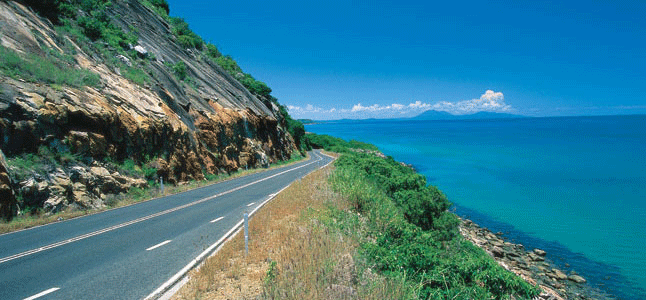
Well, I did the drive yesterday -- from Cairns to Port Douglas. About 35 miles. For about half of the time the road runs right alongside the ocean, with beaches large and small scattered all the way along. It is one of the world's most scenic drives and the wonder is that you can stop at almost any of the many unspoiled beaches and find yourself alone there. If people like to go on vacation amidst crowds, good luck to them, but if you fancy the deserted tropical island experience with none of the inconvenience of a deserted tropical island, you should be booking a flight to Cairns International Airport. It's a longer plane journey than most but droves of the notoriously quality-conscious Japanese seem to think it is worthwhile.
I also spotted another pygmy yesterday. I was sitting on the pavement beside the main street of Port Douglas having a nice cup of tea when a very small dark person walked right by my table: Less than 5' tall with legs like broom-handles. There are obviously still plenty of negrito (pygmy) genes in the area that was until recently dense tropical jungle.
Sunday, August 15, 2004
STEAM TRAINS AND PYGMIES

Either you "get" steam trains or you don't. I do. So I was mightily pleased yesterday to be sitting on a bench at Kuranda railway station (in the mountains above Cairns) when a great black old steam engine came panting in -- hauling a train of passenger carriages. It has been dragged out of retirement for the tourist trade so that makes me grateful for tourists. Stream engines don't handle inclines well, however, so the trip from Cairns to Kuranda takes twice as long as if the train were hauled by a modern diesel-electric. Anyway, it really choked me up as it slowly pulled out again amid much steam and panting. It was magnificent. Steam buffs would understand.
An historical interest of Kuranda that is now almost completely unknown to almost anybody -- and which is certainly not mentioned to the tourists -- is that the last survivors of Australia's pygmy race were found in the jungles around there. There are still quite a few striking photos of them from around a century ago, but intermarriage between them and other blacks since then has eliminated any obviously distinct modern population of them. Yet 99.9% of Australians would think that there has only ever been one indigenous race on the Australian mainland.
The existence of the pygmies used to be mentioned in the history textbooks but is now almost nowhere to be found. Why? Because the indigenous Australian blacks (Aborigines) that we know today appear to be mainly the descendants of a later wave (or waves) of immigration into Australia -- which means that they are not truly the first "owners" of the country. They are just as much invaders as the whites. And they did a pretty good genocide job on the pygmies -- so, as in Africa, the pygmies survived only in the deep jungle. And that TOTALLY undermines the Leftist guilt industry which says that whites as invaders owe the Aborigines something for being the original inhabitants here. More woes for Australia's Leftist historians. And, yes, it IS the wicked Windschuttle who has shown their deceptions up in this matter as in others.
So what did I see in Kuranda yesterday? I saw only about a dozen Aborigines there but two were remarkably short. Isn't that surprising?
Saturday, August 14, 2004
DESERTED BEACHES -- AND PAPAL ENCYCLICALS
I may be wrong but I have the strong impression that the ideal image of a tropical beach that most people have in mind is an image of a deserted beach. "Getting away from it all" largely means freedom from having to deal with other people all the time. Yet, as far as I can see, that does not happen with most tourist destinations. The crowds follow you. Yet in Australia's far North you can find plenty of long, wide, white, tree-lined, sandy beaches with hardly a soul on them for most of the time. That was certainly true yesterday when I looked in at Cowley beach, Kurrimine and Mission beach. And the smaller beaches in between them are normally absolutely deserted. The dream CAN become reality. Australia certainly makes a laugh out of the Greenie idea that earth is "overcrowded".
My vacation reading has been pretty weird. I have just read (well, most of it) the Papal encyclical Centesimus Annus by John Paul II (1991). Have you ever heard of any other atheist who reads Papal encyclicals on his vacations? There was for me one surprising bit in Centesimus Annus. The Pope supports Sabbath observance: "In this regard, one may ask whether existing laws and the practice of industrialized societies effectively ensure in our own day the exercise of this basic right to Sunday rest". I wonder why we never hear of that?
Like the famous encyclical it commemorates (Rerum novarum), however, Centesimus Annus is a thoroughly conservative balancing act. It says Communism is no good but neither is unbridled capitalism. It says there is a right to private property but not an unrestriced right. It says the State should interfere to look after the poor but it should not interfere too much. As I point out elsewhere, conservatives have always undertaken that difficult balancing. Simplistic all-or-nothing theories and systems are only for the ideologues of the Left. Because Centesimus Annus is a balancing act, however, both Left and Right can find bits in it that they like. It does nothing to check the increasingly Leftist nature of the church hierarchy. The hierarchy can use it to defend any degree of Statism except outright Marxism as being for the good of anyone who is at a disadvantage in any way. So I would call Centesimus Annus an unsuccessful balancing act. It is too vague to be useful. At least Rerum novarum took on Marxism at a time when it was a growing threat. I cannot see that Centesimus Annus does anything similarly useful.
Friday, August 13, 2004
Clinton and Etty Bay
Well bugger me! I rarely use crude language but this is an occasion for it: Bill Clinton is here in Far North Queensland at the same time as I am. I guess his taste in vacation spots is better than his taste in wives. He has been here before so he knew where he was going when he decided to come here for a vacation. I gather he is here for a few days at least. I saw an all-black Learjet on the tarmac as I flew into Cairns International Airport but now I know whom it delivered here. I hope that is all I see of Mr Amorality.
ETTY BAY

Thanks to my trusty IBM Thinkpad, I am writing this whilst leaning up against a rock and sitting on the beach at tropical Etty Bay. Overhead is a tangle of jungle trees giving me shade. Ahead of me is an expanse of fine white sand with tree-covered hills in the background that come right down to the beach. Although it is midwinter here, the temperature is balmy and I am wearing only a shirt and shorts. There's only about eight other people in sight. It is the beach to which I used to come for outings when I was a child. I know of no other beach where the jungle comes right down to the sand -- though I guess there must be others. It is of course well off the tourist map and long may it remain so. There is a small caravan park here but not much else. It is rimmed in by hills so there is really no scope for any building here. Just a tiny patch of paradise. And everybody here speaks English! To me it the most beautiful place in all the world. The whole point of my coming North on this vacation was that I just had to sit on the beach at Etty Bay once again.

Thursday, August 12, 2004
TROPICAL VACATION
I have taken a week away from my usual haunts to spend in my ancestral place. All four of my grandparewnts were born and bred in tropical North Queensland and I was too. I am at the moment blogging from Cairns -- the tourist hub of the Far North. I have been to a few tropical tourist destinations in my time -- Fiji, Hawaii, Singapore and Thailand -- and I think North Queensland is as good as or better than any of them. And I do definitely wonder why people go to third-world tropical destinations when they could enjoy every tropical experience in the safety and convenience of a modern Western country like Australia. Because I was born amid magnificent tropical scenery I am very hard to impress when it comes to scenery. I used to think that there was no scenic drive in the world better than the Cairns to Port Douglas road but these days I will concede that a drive through the Western Highlands of Scotland in the summer rivals it.
The Asians have discovered Cairns big time and the Japanese are everywhere. So that parts of Cairns remind me a lot of Asia -- with all the crowded vibrancy that that entails. So if you want to see Asia, come to Cairns! But outside the tourist bazaars, there is no crowding. So forget about tropical islands. Cairns has everything they do. Anyway, for me it is a trip home.
Subscribe to:
Posts (Atom)