Friday, June 19, 2015

Wiener Blut -- a splendid farce


And a celebration of a great city


To Americans, a wiener is either a sausage or a private part of similar shape.  But in German neither Hamburgers nor Wieners are food items.  Both refer to the inhabitants of famous cities.  So Wiener Blut means "Vienna blood".  But what exactly that is we shall see.

In my well-spent youth in Sydney in the '70s I went to a lot of plays.  Sydney had a variety of them on at any one time and I took advantage of that -- seeing perhaps one play a week.  They weren't all good -- I walked out of a few -- but I enjoyed most of them, as did the ladies I took along.  Ladies LOVE going to plays. And there were among the plays I saw quite a few farces, including plays by that master of farce, Feydeau. And Wiener Blut is an excellent farce, worthy of Feydeau.  The show was written in 1899 and set in 1814.

Also in the early 70s, a lot of cinematic versions of operetta were made for German TV.  And the best of those are  now being released on DVD -- perhaps something to do with copyright. And a lot of the DVDs I have acquired are from that source.  An amusing consequence of that is that I see from time to time the same singers in different shows.  For me the '70s German operetta scene is still live. 

So the version of Wiener Blut that I have -- a 1971 production conducted by Kurt Graunke and directed by Hermann Lanske -- actually had three singers in it whose work I knew.  One of the reasons I bought that DVD was that it had the Austrian soprano Dagmar Koller in it, who is a genuinely lovely lady.  She is of my vintage but still survives. 

The point of it all

So let's look at the theme song which tells us what Das Wiener Blut is about.  The song itself defines such Blut as "Voller Kraft, Voller Glut! ... Was die Stadt Schönes hat, In dir ruht! Wiener Blut, Heisse Flut. (Roughly: "unique, full of fire, full of power, hot and flowing").  The idea is that the great city is embodied in its people. It basically means "high-spirited" -- bright and lively -- perhaps "gay" in the old meaning of that term -- and infidelity is accepted as part of that. If a man is not smitten by every beautiful woman he meets, he lacks Wiener Blut.  But operetta always has happy endings so in this case the Graf ends up falling in love with his wife! (As well he might!)

A wonderful farce. I am laughing as I write this.  But he only falls in love with his wife because his wife suddenly falls in love with him.  She had herself been before her marriage a gay and lively  Wiener ("Ich war ein echte Wiener Blut") and had thought that her husband lacked Wiener Blut -- until she saw and heard of his infidelities.  That convinced her that in Vienna he had become a real man by Vienna standards ("Aus dem soliden und strengen Mann wurde der flotteste Don Juan!  ... Sie wurden Mann von Welt").  So, as the wife, Ingeborg Hallstein was given a sophisticate's role.  And she conveys it with complete conviction and elegance.  It makes some sense that she wanted her man to be one who was desirable to other women.  See below:


So was there more than that with Wiener Blut?  Was it just a similar culture that Hallstein's character wanted?  Partly so, I think.  But Wien was at the time a great imperial city and civilizational centre so there was also there a longing for the high and sophisticated culture that existed in Wien.   At one stage Wien was undoubtedly the greatest city in the world since Constantinople/Byzantium.  To be and feel part of that was a great privilege.  And we see from the scenes of the ordinary people of the city at Hietzing that a love of their city included all orders of Viennese society.  They compared Wien to Heaven!

But other people esteem their city highly too.  We even have a rather good song of praise for Galveston!  And who can forget Elvis's "happy home" in Memphis, Tennessee?  London is a bit disappointing though. Such an amazing city seems to have produced only the Cockney song, "Maybe it's because I'm a Londoner ..".  But nothing can compare with the frequent and brilliant songs of praise for Wien that occur throughout operetta.  And Wiener Blut is undoubtedly the leading example of that.

The casting

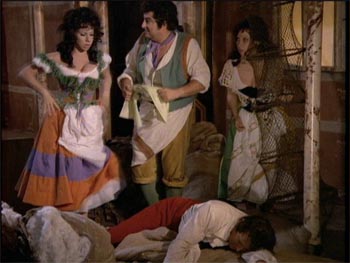
I did not think that Rene Kollo was well cast in Csardas Fuerstin  -- though he is undoubtedly a good and powerful singer -- but he suited his fickle part in Wiener Blut very well. As the Casanova he did not do any stern parts but when he was rumbled with his Geliebte in her floral and very modern underwear he managed to say "Ich auch" in a somewhat stern manner. And his surprised expressions when he encountered his seamstress Geliebte standing in for a Princess of Poland in the grand dance were spot on. The more I have listened to him, the more I appreciate his powerful and faultless tenor voice. And his diction is good too.  Regardless of the language of the song, operatic singing is often hard to follow, but Kollo's German is very clear.

But the real surprise for me  was German soprano Ingeborg Hallstein, of whom it has been said:  "Ingeborg Hallstein burst onto the scene in 1959 with an uncommonly sweet voice and beautiful face and figure, which immediately moved her front and center in German musical life."

There is a lot of her work available on CD -- for good reason -- but almost nothing on DVD.  But what a lady! An elegantly beautiful woman.  She conveyed eloquently the air of sophistication that her role as Graefin called for.  She really has the sort of face that would launch a thousand ships -- a face of both character and beauty. And she has the long neck that one normally finds only in beautiful Northern European women.  Virginia Woolf was another example. So Hallstein was a most convincing Graefin!

But is her beauty in part a function of stage makeup?  I don't discount that. On the few occasions that I have appeared on TV, I have been amazed about how the makeup artists were able to banish my facial spots.  But we do  get a lot of closeups in this show that clearly show Hallstein's stage makeup.  And it clearly just emphasizes already beautiful features.  

There is one thing that I am not sure that I should mention. Hallstein has some sort of mole on her lower face.  So why did not the makeup artists blot that out?   There was apparently in times past such a thing as a "beauty spot" and that idea still lives to some extent.  Don't ask me for the logic of it (if any) but some sort of facial blemish on a beautiful lady was held to be an enhancement rather than a blemish.  So Hallstein has it all.

KS Hallstein is a remarkable singer too.  She is known for her range and she does show a bit of it on a couple of occasions in this show.  It is not a big voice but it is probably just right for the ultimate lady that she is. Needless to say, she has long been recognized as Kammersängerin (KS).

If you want to really hear what she can do as a high coloratura soprano there is a 1965 B&W film clip below where she sings the haunting nightingale song by Franz Grothe from the 1941 German film "Die Schwedische Nachtigall".


Hallstein has been described as having crystal bells in her throat and that clip will tell you why.  (Lyrics for the nightingale song here).  In a sound-only file here you also hear her in high coloratura mode -- singing the wonderful An der schoenen blauen Donau, Austria's unofficial national anthem.  

The Donau (Danube) is shown in appropriate blue in the map below -- though I gather that it is rarely blue these days:


Hallstein was said in the 60s and 70s to be "die weltweit beste Königin der Nacht" (the world's best "Queen of the Night") and I can believe it. She is still alive and active on judging panels in her late 70s.  

Note: There is also a "Spanish" nightingale operetta, "Die Spanische Nachtigall" by Leo Fall. And also a Nachtigall song in Zeller's Vogelhaendler. You have to keep your nightingales straight.

And Hallstein's facial expressions and body language were brilliant too. She is a superb actress as well as a remarkable singer.  It seems to come naturally.  It probably does. She is as good as any Hollywood actress at living her part and better than most of them at subtlety of expression.  

An example of that which I really enjoyed was her very small but rightly contemptuous gesture of dismissal -- mainly just a tiny and momentary inclination of her head combined with a small "Oh!" -- when she first saw one of her rivals, little Helga. Her vocalization there was not even an Ach!.  She knew that she was miles ahead of that "rival".  And the scene where she asks the clumsy Prince to take her to Hietzing was brilliantly done.  I laugh every time I think of it.  It was almost an enchiridion of feminine wiles there.  She knew her power and even found it amusing.

And her expressions as she spoke with her flirtatious husband were also well done. She showed subtly that she did not believe a word of his attempted deceptions but was amused by them instead -- indulgent and quietly confident expressions.  She was aware of her high standing in Wiener society so was not easily abashed.  She has irrefragable dignity.

I have seen and heard other versions of the Wiener Blut song but I think Hallstein here is better than them all (see the clip above).  What a stunning woman!  The other women in the show are girls compared to her.  That clip may in fact get my vote for the most beautiful scene in operetta.  There are other strong candidates  -- such as Die ganze welt is Himmelblau with A.K. Wigger at Moerbisch in 2008 or Martina Serafin's in Als geblueht der Kirschenbaum in the Moerbisch performance of Vogelhaendler but  the emotion is so intense in the above scene that it certainly gets to me.

Not that I would say a critical word about the other two ladies in the show. Dagmar Koller once again came across as a lovely and lovable lady. Let me say that again: Despite what could have been a bitchy role, Dagmar Koller once again came across as a lovely and lovable lady.  She is a honey.  I suspect she would not accept casting any other way.  

And little Helga Papouschek as the servant's girlfriend was well cast. She has a certain prettiness but is no beauty -- a point made in the show when the two beautiful ladies (the Graefin and "Cagliari") agreed that they  could forgive the Graf that one.  She was in their view no threat to them. Wiener Blut!  

She has been described elsewhere as a "vielseitige Schauspielerin und Sängerin" (a many-sided actress and singer) and I can see that. She has a squeaky little voice but she gets her notes well enough.  She portrayed various moods very  well and looked right for her part.  She certainly showed various sides in this show.  And her role as a seamstress in a Polish hat standing in for a princess of Poland in the grand dance was one of the good jokes of the show.  And her  comment earlier on in the show that the overweight Polish princess might have been overdoing the cakes was as irreverent as it was apposite.

And we must not for a moment forget the character actors. Benno Kusche did his part as the confused Prince superbly well and Ferry Gruber as Josef the servant was very convincing.  He was very clever in fact.  He was as good a character actor as you could get and he certainly got the laughs, probably about half of them in fact.  There was brilliant acting throughout the show.

The costumes

A small note about riding habits:  I was much impressed with the riding habit worn by "Lisa" in Das Land des Laechelns but the outfit worn by Hallstein in this show was pretty good too.  I think that up until now I had only seen Englishwomen in riding gear.  Austrians do it infinitely better.  There is a low rez clip below that gives you an idea of Hallstein's outfit -- and also follows her into her visit to her old home at Döbling.  The beginning of the clip shows her actually riding a horse so the outfit was apparently practical.  She looks good most of the time but in her riding habit and riding hat she was really something  -- both while riding and after riding. 


Part of the attractiveness of the riding scene was the beautiful grounds through which she trots her horse. I gather that that scene was recorded in the grounds of the Palais Strattmann in Vienna.

I think the point of such an elaborate habit is that you could get off a horse and immediately be dressed for the best society.  I note that the lovely Dagmar Koller was also presented in a flowing riding habit in the vignettes of her pre-marital times in Csardasfuerstin

The golden garment with lots of ermine trim on the hood and sleeves that Hallstein wore to Hietzing also impressed me.  Not everyone could have worn such a garment effectively but on Hallstein it created a great image of privilege and luxury.  It complemented and framed her beauty.  A face framed in ermine certainly has a good start.  Dagmar Koller also wore a similar rather gorgeous flowing garment at Hietzing.

Some of the scenes at Hietzing below


The garments both ladies wore were dominos, all-covering garments often worn to masked balls and the like. They are a way of hiding in plain sight and both ladies in this story were indeed trying to hide at Hietzing. There are some modern ladies' garments called that but they are totally out of touch with the late-19th-century original, with its hoods, big sleeves, fancy trims and the like.  Below is a picture of a lady wearing a pink domino at a performance of Heuberger's Opernball


And Hallstein looked so happy in that scene.  Good to see.  I suspect that she is basically a happy lady who suppressed her good humour only slightly in the scenes where she is dealing with the attempted deceptions of the Graf.

Perhaps the elaborate Fächer (hand-held fan) much used by Hallstein in the show deserves a mention.  It is very feathery and is obviously meant to be part of a lady's ensemble rather than merely utilitarian.  She certainly uses it expressively.

Hair!

Interesting that Hallstein wore small stars in her hair for much of the time.  In operetta it is very common for the ladies to wear laurel wreaths  -- but not in this show:  Diamond stars as a hair adornment were invented by the rather tragic Empress Elizabeth of Austria around about 1860 so seeing them in this  show (set in 1814) is a bit anachronistic but certainly glamorous.  They do convey elegance.  Anne tells me that you can still buy in Vienna hair stars such as Hallstein wore.  So perhaps that is the practical reason why they were used.

It was Anne who told me about hair stars. I know nothing about the mysteries of ladies' hair, other than having a general view that more is better.  I have even bullied Anne into wearing her hair long, even though she is a lady of advanced years. I have of course scriptural support for my view of the matter (1 Corinthians 11:15) but even in the human race's oldest literary work, "The epic of Gilgamesh", we find a view that long hair is proper for women.

And I still have not figured out how Schellenberger in the one year (2004) had both very short hair (in Graefin Maritza) and very long and gorgeous hair (in Lustige Witwe).  Lustige Witwe  could have come first, of course, but as a "Daily Mail" reader I am aware that there are such things as hair extensions -- but I have no idea how that works at all.  But when Gilfry was fiddling with Schellenberger's hair in the Lippen  Schweigen scene I was mentally warning him to be careful of those extensions.  Fortunately, he was.

A few other details

Some of the jokes come very quickly and you have to be alert to get them.  One such was when Hallstein was offered a jumping jack but she declined to buy, saying as the seller walked away:  Ich hab' schon eine (I have already got one) -- meaning probably her husband. Another joke was the stern and prowling geheime Staatspolizist (secret policeman) at Hietzing in his brown hat. (OK.  He was just a Geheime Polizist.  We know who in history the Geheime Staatspolizei were, don't we?)

I was amused when the sausage king described Hallstein as "a dazzling piece of construction" and her rival as an "architectural masterpiece".  We see architectural allusions to the looks of a lady in other operettas too, notably Kalman's Graefin Maritza and Lehar's Die lustige Witwe.

And I also wonder a little what the sausage king's sausages were like.  As a sausage devotee I entirely agree with the prominence they were given in the show.  My devotion to sausages could make me a good German.  A good sausage is a work of art!

When the Graf is trying to seduce the wily seamstress with invocations of Stoss an (drink up), he orders Wiener Wein to help the proceedings.  I wonder what the wine was?  The most popular Austrian wine these days seems to be Grüner Veltliner, which is a rather undistinguished wine IMHO -- reminiscent of an Australian Hunter Valley  Semillion. Maybe he had in mind Gemischter Satz, which would have been around in the early 19th century.  

Gemischter Satz is in fact grown and produced in Vienna itself. So it really is a Wiener Wein. Vienna actually has its own vineyards on the outskirts of the city. Austria as a whole is a significant wine-producing region.  It exports to Germany. I noticed at the big party in Hietzing that everyone seemed to be drinking wine, not beer.  Not a North/South difference this time, I think.  Maybe just a Wiener difference?  

We saw a North/South difference when the (presumably) Northern Prince told the (Southern) sausage king to speak German, remarking that the sausage king's German sounded like Tibetan.  In good Southern style, the sausage king was not at all abashed and just carried on. There was rather a lot of commentary about Wiener speech being "different" and I gather that there are still such differences.

I am no authority on anything German and I know only the basics about North/South differences but I noted that the sausage king pronounced junge Leute as junge Leiter and there is no doubt that could cause amazement or amusement.

Another detail of the show that interested me was the novels the Graefin took out of her bookcase.  Because I had never heard of him I looked up Christoph Martin Wieland.  He was apparently a rather light novelist, best known for translating Shakespeare into German.

Realism and operetta have a limited relationship -- though I don't like deliberate anachronism.  So I cannot be censorious about a very curious thing about the streets of Vienna that we see in this  show: The streets were sparkling clean.  But the streets of of a great city in the 19th century would have been much used by horses and various horse-drawn conveyances.  And what does that produce?  Huge amounts of horse-manure and horse-pee in the streets.  The real-life streets of Vienna at that time would have stunk to high heaven and soiled anybody who walked them. Sorry for that totally inappropriate burst of realism.

The wrap-up

As endings go, this has to be the supreme operetta -- with FOUR happy couples at the end of it: All waltzing and singing Das Wiener Blut of course. Superb, superb! (As the  French Vicomte said in  Lustige Witwe when he heard that the widow was worth 500 million francs). Even the sausage king finds his match. 

It's hard to believe that the show was initially a flop.  Bizet died thinking "Carmen" was a failure too. The first producer of Wiener Blut was bankrupted by its failure and shot himself!  A terrible contrast between reality and fantasy. 

And the praise of Vienna as being unique and happy is of course common in operetta. One thinks of the joy in the two second-string stars of Zirkusprinzessin when they discover in cold St. Petersburg that they are both from warm Wien.  And the Princess in Vogelhaendler at her first appearance in that play is also proud to proclaim that she is a gay Wiener.  But a heterosexual one, of course.

And, as usual in operetta, the waltz (Der Walzer in German) is both much practiced and warmly praised.  And something I noticed at the end of one of the waltzes was that the ladies did a low curtsey to their men at the end of the dance.  I am aware that there can still at formal balls be a certain amount of bowing and curtseying at the beginning of a dance but I had not seen it as the conclusion of a dance.  Is that still widely practiced?  I have no idea.  But someone should bring it back routinely.  It would make the feminists burst into flames!

Some reflections

And an inevitable reflection that Wiener Blut inspires is how we mere mortals live up to the splendid life in Wien that it portrays.  I am sure I score a zero on glamour but, although I am no Wiener, the fact that I have been married four times to four fine women must testify to some sort of "Blut"!

But have I had in my life an ultimate lady such as Hallstein?  A lady who is beautiful, smart, confident, socially acclaimed, very musical and kind?  And have I walked through a crowded room with the lady to see her greeted with pleasure by many? (As Hallstein did with Kollo in the grand ball)?  I have done that. And I treasure the experience.  She may even read this.  Unlike Hallstein, she does not have crystal bells in her throat but I think we can both overlook that.  A real lady is a great pleasure to us mere men.

And what is the role of culture in male/female relationships?  With the lady I mentioned above  it was  very important.  She once said to me:  "I could forgive you anything because of the way you feel about music".  But there is more to it than that.  

The lady in my life these days is in fact a good soprano but that is rather incidental -- though we do sing some of the great old Protestant hymns together at times!  What she and I have in common is small-town Protestant Queensland culture.  We come from very similar environments. When I speak broad Australian she understands. We sound right to one-another.  It really pleases me to use traditional Australian expressions.

The great aria

Here it is in full:

Das Wiener Blut! 

Wiener Blut!
Wiener Blut! 
Eig'ner Saft 
Voller Kraft, 
Voller Glut! 

Du erhebst, 
Du belebst 
Unsern Mut! 

Wiener Blut! 
Wiener Blut! 
Was die Stadt 
Schönes hat, 
In dir ruht! 

Wiener Blut, 
Heisse Flut 
Allerort 
Gilt das Wort: 
Wiener Blut! 

I know the literal meaning of all the words but it would be maddening to try to translate it adequately so I am not going to try.  Someone bolder than I am has however subtitled it  here in an old performance by Elizabeth Schwarzkopf.  Rather sad that the undoubtedly distinguished Schwarzkopf is roughly twice as wide as Hallstein.

Librettos are online here and here but performances of course differ so neither  corresponds exactly to the DVD performance
Perhaps I should in closing pay tribute the librettists, Victor Léon and Leo Stein. The fun was entirely their work.  A later libretto for which Léon and Stein were responsible was that of Lehár's highly successful "The Merry Widow". Strauss was in his last days when this show was created and, although he approved of the project, he did not specifically compose any music for it, although many of his earlier compositions were incorporated, as we can hear. He was mostly content to delegate the musical arrangements to Adolf Müller. You have to get your Adolfs right!  -- JR


Wednesday, June 17, 2015

Das Land des Laechelns


This blog was not at all designed to attract a large audience.  It was designed primarily as a backup to my appalling memory of events in my own life and secondarily as something that a few people who know me well might like to read.  As a distant third it could function as something that people with similar interests to mine might come to via the inestimable services of Google.

But I imagine its already small audience may have shrunk this year.  "It's all full of bloody German these days", I can imagine  people saying.  And German does come across as a rather intimidating language, I think.  But for better or worse German is the language of classical music so a love of the music does tend to lead to texts in German. I do try to translate most of it but that would be too big a job with libretti etc.

Anyway, I had a rather eventful day yesterday by my humble standards. At lunchtime I drove to Tingalpa in my 1963 Humber Super Snipe to see Anne and her friend Lola.  An outing in the Humber always gives me some sense of an occasion and it gives that to others too.  I get the sort of praise for driving it that owners of those combustible supercars can only aspire too, I imagine.  Given the heat that their mighty engines produce, I suppose it is no wonder that supercars regularly burst into flames and end up as charred wrecks. The Humber is a powerful car but nowhere near that powerful, thankfully.

I don't drive the Humber much these days so it was around a month since I had started it up.  The battery was by then pretty flat, but, with good Humber engineering, the motor did start anyway.  I drove it yesterday both because I might have risked some sort of corrosion had I left it longer and also because Lola is British (in an East African kind of way) and I knew she would be pleased to see such a splendid old British car.  Britain still produces a lot of cars but they almost all bear names such as Honda, Toyota and Nissan these days.  Though Jaguar has made a comeback under Indian ownership.

So when I got back home from Tingalpa I wrote up a small but predictably eccentric memoir of the occasion and then proceeded to compile my blogs for the day -- which I managed despite a more limited timeframe than usual.  I even managed to write a few derisive comments about Global Warming and the Leftist "New Matilda".  Writing takes time so my memoir had to be the only extended thing I wrote yesterday.

But the climax of the day lay ahead at that point.  I received during the day a DVD of a "new" (to me) operetta: Lehar's  Das Land des Laechelns. So late in the evening I sat down to watch it.


I have the 2001 Moerbisch performance of the show. Das Land des Laechelns means "The land of smiles" -- i.e. China.  I was very curious to see how a Viennese composer and his librettists would write about China!    My skepticism that Austrians could write reasonably about China in 1923 was actually rather unfair.  Chinoiserie had been very popular even in the late Belle epoque (before WWI) so China was hardly a mystery by then. And interest in the Far East generally had been greatly aroused in 1905 when Japan's admiral Togo sank most of the Russian navy!

The opening scenes of operetta are often pretty forgettable and I tend to skip them on re-watching a show but the opening brackets of this  show were all devoted to showing the supreme grace and elegance of the great city so were very pleasing to watch.

The story

The show was basically in two parts: First in Vienna then in China. The first part was where most of the jokes were -- though the eunuch scene in the second half of the play had some very good lighter moments too.

The story is that a Viennese lady and a Chinese prince fall in love in Vienna and both then go to China -- with unhappy results.

The idea that a smallish East Asian man might fancy a big blue eyed blonde from Northern Europe was very plausible. For better or worse, the Nordic ideal of beauty is the default ideal worldwide.  Something like 95% of the world's blonde ladies were not born that way.  Even in Japan, ladies blond their hair.

Blue eyes are also much admired but, unlike hair, eyes are not so changeable. I checked my blue-eyed privilege and married four blue eyed ladies -- so I have a blue-eyed son.  And his blue-eyed GF augurs well for the next generation. Leftists these days often tell us to "check your privilege" but I don't think they would approve of my version of that.  Their version is just Marxist claptrap anyway.

In part 1 of the Singspiel we first heard the famous "Dein ist mein ganzes Herz" ("You are my heart's delight"). It is a great and famous aria and was originally written by Lehar for Richard Tauber so it seemed a bit strange to hear it sung by an Asian  tenor. Sangho Choi gave an impassioned performance, however, so did it justice. Tauber sings it in English here. I am inclined to think that the Korean (Sangho Choi as the Chinese Prince)  sang it better, actually. The audience at Moerbisch certainly applauded it heartily.

And the second half of the show was surprisingly dark and tragic for an operetta.  The lady goes to China but can't fit in there so has to make her escape.  Her lover reverts to Chinese form and she ends up tragically by declaring to him:  "Ich hasse dich" ("I hate you").

So the ending is low-key by operetta standards. The lady and her Viennese admirer are happily reunited and escape back to their beloved Wien but the Chinese players are left desolate. Not good. Had it been grand opera, everyone would have died, so we have to be thankful for small mercies, I suppose.

It's interesting how times have changed.  Wien was once THE city and China was a backwater.  These days it is just about opposite to that.

Costumes

I was MOST impressed by the magnificent riding habit "Lisa" (Ingrid Habermann) wore for her entry to the show.  I have not seen anything before remotely as good.  It must be Austrian elegance.

And the military hats on the men in the early scenes initially rather confounded me. They were such an unostentatious type of shako that I thought at first that they were French pillbox caps. But in fact we see below the unfortunate Archduke Ferdinand in a similar shako. The costume department did their homework.


Speaking of hats, was this the first time Serafin trotted out absurd green plumes on his hat?  He did it in Weissen Roessl too.  A good comic touch.

Towards the end of the first part, I loved the old car that took "Lisa" away.  A bit like a very well-appointed A-model Ford.

The cast

And we got in part 1 a good introduction to Ingrid Habermann as the lady the Chinese Prince fancied -- a regal and classically good looking Vienna lady with blue eyes and a great mop of blonde hair.  I would have fancied her too. I did, after all, once marry a lady with a great mop of blonde hair.  Habermann was presented as the aspirational Austrian lady, even wearing a substantial tiara at one stage -- showing her as a princess of Viennese society.

The contrast in appearance between Habermann and her Chinese admirer was of course deliberate.


Habermann is actually Austrian -- from Linz -- so the part would have been very congenial and easy for her. She really is an aspirational Austrian lady.  Even the blonde hair may well have been real.  The age of most operatic ladies seems to be a State Secret so I was not able to ascertain her DoB but I suspect that she was in her 30s for this show.  She was a touch "broad in the beam" for youth, if I may add a nautical simile to the architectural similes that one sometimes finds in operatta.

Austria is in fact rather Southerly in Europe but the Nordics from both the North and South coasts of the Baltic have been marauding South for well over 2,000 years so seem to have left rather a lot of their genetics in Austria. So much so that we hear that Die ganze Welt ist himmelblau there.  There are some brilliant blue eyes in Austria to this day.  Austria looks like a rather nice bit of territory so maybe a lot of Nordics never went home from there.

But the show was a magnificent part for Habermann and she went from strength to strength thereafter.  Moerbisch has been a place of takeoff for many singers and I am hoping that will work for Cornelia Zink (seen in Bettelstudent) as well.

Intendant Harald Serafin gave most of the jokes in the show  to himself.  He is very good at comic parts so that was fair enough.  He always took a part in Moerbisch performances as well as directing them.

He got his post at Moerbisch because he was already a great actor and singer and I have always liked him in his various roles.  Even in 2011 when he rather lost the plot at Moerbisch he did his own part very well.

Apparently I was not the only one who thought he lost the plot in 2011. The year after 2011 his audience at Moerbisch declined -- resulting in him being retired against his wishes.  So Schellenberger got his job.  And she did it well, with audiences numbers recovering in 2013 (with Bettelstudent).

After watching the show  again, I still laughed at all the jokes again.  Serafin delivers them expertly.  His dry comment on a Chinese "dirndl" was exquisite, as was his non-recognition of Confucius.

But Serafin does his tragic scene well too. His tragic final call to his departing daughter not to forget Vienna is very significant.  As I have argued previously, Vienna at that time was what New Yorkers think NYC is -- the center of the civilized world.  And she later did admit with passion how much she missed Wien.  Only in her hometown could she be "free".  New Yorkers would understand.

Speaking of jokes, another was when "Gustl" (Gustav) in the second half excused himself from being a fickle Viennese by saying that he was from "Burgenland", I thought that was quite good.  The audience did too.  That got a laugh, though not a big one. Burgenland is of course where Moerbish is located.  But Mitani's reply was good too: "Isn't that the same?"  Moerbisch and Vienna are only about 60 kilometers apart, from memory.  Most of the shows from Moerbisch do incorporate some reference to it -- most often in a complaint about the mosquitoes there.

And I must pay some tribute to Yuko Mitani, the Japanese soprano playing the Prince's sister.  Having a Japanese playing a Chinese was no problem, of course.  They all look the same, you know.  Jokes aside, however, by her manner she could have been a Viennese lady.  I guess it shows how much of Western culture Japan has absorbed.  She was certainly as expressive as one could wish, quite un-Japanese, it seems to me. The show was part-sponsored by NHK in Tokyo so perhaps it all fits somehow. Most of Mitani's singing history has been in the German lands.

A final point of amusement: There were no actual Chinese in the show. The Chinese parts were mainly played by Japanese plus one Korean (Sangho Choi). Serafin would have got into trouble if he done that in politically correct America.  And even I am a bit stunned to find that Sangho Choi is an acclaimed interpreter of German Lieder.  What is the world coming to? Sangho Choi deserves his success, however.

The show is also reviewed here, with a more comprehensive account of the plot.


Tuesday, June 16, 2015

A lunch with Yersinia pestis


Anne shouted me a lunch today of some very good North African tagine.  The lunch was so I could meet an old friend of hers.  And I mean old.  Lola is 90 but still has all her marbles.

I started out the meeting with a conversational gambit you won't find in any etiquette book.  I guess it's my pesky sense of humour again but I started by offering some comments about Yersinia pestis.  But both Anne and Lola are intelligent persons so that was treated as interesting.

I pointed out that we are all survivors of people who did NOT die during the Black Death, even though the epidemic took off about a third of the inhabitants of England.  So if there were a new such epidemic, the chances of survival for most of us would probably be quite good even without antibiotics.  And Yersinia pestis hasn't gone away.  There were some cases of it in Madagascar recently, of all places.

I then went on to say that it was probably the people in poorest health that died in the 1300s anyway.  I supported that by an anecdote from my childhood.  We oldies tend to talk a lot about our childhoods.  

The story is that TB was making something of a nuisance of itself in the Australia of the 1950s so the government decided to immunize all schoolkids against it with the remarkable BCG vaccine, a French product.  But to avoid waste they did not vaccinate everybody.  

They first did a Mantoux skin test on all us kids to see if we were already immune to TB. And all but one of the kids in my class returned a positive response.  We had already had TB without knowing it and were hence immune and in no need of any vaccine. For us well-fed and healthy kids in the benign tropics, TB was experienced just as a mild bout of 'flu and we had fully recovered from it.  So even nasty infections and viruses can be batted away if you are in generally good health.

The conversation strayed into other channels after that, with Rhodesia getting a mention.  Lola is of British East African origin and, at university, I once headed an "Australia/Rhodesia society", which was a very successful bait to the campus Left.

But Anne's food was good.  To complement the tagine, Anne had bought a big loaf of unsliced bread from her local Chinese bakery -- and that baker sure knows how to bake good bread.  So with plenty of butter out of Anne's antique butter dish, I enjoyed it muchly.  

Anne wanted to offer us some wine with our lunch but neither Lola nor I drink during the day so Anne stayed "dry" too, not entirely to her satisfaction.  I did entertain Lola with stories about Anne's dedication to "Barossa Pearl", a dedication which I share, not being a wine snob.  So we finished with a nice cup of tea -- "Bushells", the tea of flavour -- and an Anzac biscuit.

On rare occasions when I enter snooty coffee joints and ask for tea they complacently ask me which tea I want -- English Breakfast, Earl Gray etc.  I always reply: "Bushells", the tea of flavour".  They look at me as if I am mad. Australia's most popular tea is terminally uncool to them. I enjoy that reaction.  I am a born tease, particularly of pomposity.

UPDATE:  In case anybody is interested, a new drug to treat plague has just been approved in the USA. Excerpt below:


Sunday, June 14, 2015

Did Bach set Psalm 23?


As I have mentioned previously, the most popular setting of Psalm 23 is Crimond, from Jessie Seymour Irvine, but many composers have set it.  So did the greatest religious composer of all time also set it?

He did but not in the way often asserted.  His aria "Sheep may  safely graze" is often said to be his version of Psalm 23 but its wording has next to nothing in common with the psalm.  See the words below:

Schafe koennen sicher weiden,
Sheep can safely graze
Wo ein guter Hirte wacht.
where a good shepherd watches over them.
Wo Regenten wohl regieren,
Where rulers are ruling well,
Kann man Ruh und Friede spueren
we may feel peace and rest
Und was Laender gluecklich macht.
and what makes countries happy.

The aria is sublime music but it in fact is part of a whole cantata devoted to currying favour with his aristocratic patron, Duke Christian.  It is not religious at all.  The aria is from Cantata 208: Was mir behagt, ist nur die muntre Jagd ("Hunting is the only thing that satisfies me").

Bach left few tempi notations in his MSS but most conductors do it as an adagio, though largo would also defensible and some conductors have adopted that.  I am with the majority there. Sir Neville Marriner's interpretation below. It is so beautiful it makes me cry:


The cantata (no. 112) that does contain a setting of the psalm is "Der Herr ist mein getreuer Hirt" -- to a German text by Wolfgang Meuslin.  It's on YouTube e.g. below:


The words:

1. Coro
Corno I/II, Oboe d'amore I/II, Violino I/II, Viola, Continuo

Der Herr ist mein getreuer Hirt,
Hält mich in seiner Hute,
Darin mir gar nichts mangeln wird
Irgend an einem Gute,
Er weidet mich ohn Unterlass,
Darauf wächst das wohlschmeckend Gras
Seines heilsamen Wortes.

2. Aria A
Oboe d'amore solo, Continuo

Zum reinen Wasser er mich weist,
Das mich erquicken tue.
Das ist sein fronheiliger Geist,
Der macht mich wohlgemute.
Er führet mich auf rechter Straß
Seiner Geboten ohn Ablass
Von wegen seines Namens willen.

3. Recitativo B
Violino I/II, Viola, Continuo

Und ob ich wandelt im finstern Tal,
Fürcht ich kein Ungelücke
In Verfolgung, Leiden, Trübsal
Und dieser Welte Tücke,
Denn du bist bei mir stetiglich,
Dein Stab und Stecken trösten mich,
Auf dein Wort ich mich lasse.

4. Aria (Duetto) S T
Violino I/II, Viola, Continuo

Du bereitest für mir einen Tisch
Vor mein' Feinden allenthalben,
Machst mein Herze unverzagt und frisch,
Mein Haupt tust du mir salben
Mit deinem Geist, der Freuden Öl,
Und schenkest voll ein meiner Seel
Deiner geistlichen Freuden.

5. Coro
Corno I/II, Oboe d'amore I e Violino I col Soprano, Oboe d'amore II e Violino II coll' Alto, Viola col Tenore, Continuo

Gutes und die Barmherzigkeit
Folgen mir nach im Leben,
Und ich werd bleiben allezeit
Im Haus des Herren eben,
Auf Erd in christlicher Gemein
Und nach dem Tod da werd ich sein
Bei Christo meinem Herren.

Monday, June 8, 2015

Why I like Austro/Hungarian operetta


Austro/Hungarian operetta is light-hearted opera written  around a hundred years ago principally for the entertainment of the inhabitants of Wien (Vienna) which was at that time the capital of an ancient and major European state, the Austro/Hungarian empire.

Before the 19th century, opera was fairly cheerful. And among his 22 operas, Mozart in particular wrote a lot of Opera buffa, comic opera.  Comic or not, just the brilliant overtures of some of Mozart's operas reduce me to tears of joy. There is something unearthly in Mozart, for those who can hear it. But even Handel operas had a lot of joy in them.  At the finale of Giulio Cesare, for instance, we find in the finale everybody lined up and singing lustily a triumphant song.

But in the more famous 19th century, French and Italian opera became much more morbid.  They are romantic but everybody seems to die at the end of them. In "Carmen", for instance, Carmen gets stabbed to death by her jealous lover and in "Aida" the lovers end up immured.  So I enjoy the wonderful arias from 19th century French and Italian opera but I have never been inclined to watch much of the operas concerned:  Too bleak for me.  So for a long time, my liking for opera stopped at Mozart.

I have long been familiar with the more famous arias from operetta but grand opera had long put me off wanting to watch anything even vaguely recent.  About 6 months ago, however, I somehow got motivated to have a look at the more famous operettas, starting, of course, with  Im weissen Roessl, "The white horse inn" -- in the Moerbisch performance.  I was immediately enraptured: good music, great jokes, attractive singers, joyous dancing, total romance and a gloriously happy ending.  What more could one ask?  Realistic it was not but great fun it was. I must have watched the show somewhere between 30 and 50 times by now but I still laugh at the jokes every time.  They are that good.

And subsequently, of course I have watched many more Austro/Hungarian operettas, by Lehar, Strauss II, Kalman and others.  They are frivolous escapism but after reading and writing serious stuff about politics all day, I watch them at night and that balances out my day.

Operettas and indeed most operas are romantic -- even though the outcome differs.  I am inclined to think that the most romantic of all is Zarewitsch by Lehar. And in true operetta style, advancing the romance by getting the heir to the throne of all  the Russias drunk on champagne is a definite classic.  Vienna was never a place for teetotalling.  There must have been trainloads of champagne going from the vineyards of France to Vienna.

Anne, the lady in my life, has always been a singer -- both as a soprano soloist and as a chorister.  She even used to sing on street corners with the Salvation Army -- back when they still did that -- something that greatly enhances my respect for her.  I remember those meetings.  The participants showed true obedience to their Lord (Matthew 28: 19,20). So after many years of singing, both on stage and off, Anne knows opera well.

She seems to have a particular liking for Wagner, which is fairly common among opera buffs. She has certainly put in the hours watching it.  The thought of sitting and watching a Wagner opera for hours on end seems to me unutterably boring however.  But De gustibus non disputandum est, of course.

So recently I was discussing Wagner with Anne and I said to her that his stuff was too heavy for me.  "I prefer Viennese frivolity", I said.  Anne replied: "You can have it". But she knows the main arias from operetta quite well so she was speaking from knowledge.  And we still like a lot of the same classical music so my devotion to operetta is forgiven.

Although it is easy to enjoy, I would like to make the case that it is actually very sophisticated entertainment.  For a start, the artistic requirements of both grand opera and operetta are quite high. The vocal feats required of the singers are maximal in both genres and good acting is, if anything, even more important in operetta.  Putting a joke across requires some very good timing and expression. And it is broadly the same singers who sing in both.

Secondly, Austro/Hungarian operetta was written for people who had it all.  They lived at the heart of an enormously rich civilization.  Vienna before WWI was not only a great and rich imperial capital with many nations under its rule but it was also at the cutting edge culturally and intellectually.

It was, for instance, the time and place of the immensely influential Sigmund Freud, by far the leading psychologist of the time. He was a great observer and I  quote him occasionally still. And the immense distinction of Vienna in analytical philosophy cannot be gainsaid -- Schlick, Wittgenstein etc.  And in economics the luminaries of the prewar Austrian school (Carl Menger; Eugen Böhm Ritter von Bawerk etc.) are honoured to this day -- though not among Leftists.  Vienna had a very good claim at that time to be the intellectual capital of the world.

And, musically, it started out on top -- with the enormous heritage of the great Austrian composers -- Mozart, Haydn, Beethoven, Schubert etc -- so any new compositions had a lot to live up to.  And the wonder is that some composers stood out even in that environment -- with Strauss II being merely the best known of many.  And there were vast numbers of innovative Viennese artists too, led by Klimt in particular

So the Viennese had it all. And what you want when you have it all is entertainment.  And to be entertaining to such an indulged and sophisticated audience you had to be pretty good.  So I see the lightness and frivolity of operetta not as trivial but as a major cultural achievement.

BTW: I ate last night at a new Indian restaurant in Woolloongabba, the "Delights of paradise".  And the food rather amazingly lived up to that ambitious name.  But it was SLOW in arriving so I ended up watching a goodly portion of a Bollywood movie while I waited.  And it struck me that Hindu movies have a lot in common with operetta.  Both have a LOT of singing and dancing, principally, though the Indians have yet to discover the joy of the waltz.

As far as I can tell, waltzing seems to have a rather staid reputation in the Anglosphere but it is not at all staid in Austro/Hungarian operetta.  The joyous climax to a waltz can be where the lady throws her arms out wide while the man spins her around with his hands on her waist only.  That is very exciting.  Feminists would hate it. So I hope that Indians will discover the waltz some day.  I gather that Indian movies are very romantic so let me close with a famous line from Im weissen Roessl:  "Ein Liebeslied muss ein Walzer sein" (A song of love has to be a waltz).


Feminists would hate the scene above but I'm betting that the lady concerned was pleased to be there.

Saturday, May 30, 2015

Eine Nacht in Venedig


I have now watched another Strauss II operetta -- Eine Nacht in Venedig (A night in Venice).  The piece premiered in 1883.  It  is said to be one of Strauss's three most recognisable stage works alongside Die Fledermaus and Der Zigeunerbaron so I have now watched all three. The setting is in the eighteenth-century. The performance I watched was a 1973 one directed by  Václav Kaslík.  It was a cinematic version using resources from Munich.

I read: "Late in 1881 Strauss began discussing a new operetta with F. Zell (pen name of Kamillo Walzel, 1829-1899) and Richard Genée (1823-1895). Walzel created the dialogue and Genée the song texts. Eine Nacht in Venedig received its première at the new Friedrich-Wilhelmstädtisches Theater in Berlin on October 3, 1883".

The story

The show is undoubtedly a classic farce -- worthy of Feydeau.  It was particularly good in the second half, with a kaleidoscope of improbable and amusing happenings.  

It's basically about infidelity, with the men being lecherous but the ladies triumphing in the end.  Infidelity has of course long been a theme in opera and operetta.  There is a lot of potential for laughs in it.  And this show is certainly light-hearted, making full use of absurdity for comic effect.  A good scene was when the fat old ladies accosted the duke in his bath.

The music is good, the singing is good, the acting is good and the ladies are good-looking but I didn't really like the plot.  It involved constant  lying to women, which I abhor.  Women hate being lied to and I just don't do it.  Women will put up with a lot as long as they trust the man concerned.  And I have probably got away with more by being honest than I would have done by lying.  I could give examples but that might be too much information.

And I don't claim any great virtue by being honest.  It is just how I am made.  By lying you are admitting that someone else's value system is superior to your own.  And I don't do that.  My Presbyterian upbringing probably contributes a little too.  I remember being given a good grounding in the Ten Commandments at Sunday school during my childhood:  "Thou shalt not bear false witness ..." etc.

The casting

I didn't much like Anton de Ridder as the Duke. He didn't look manly enough for that role in my view.  Though that is arguable, of course.  And his song Treu sein, das liegt mir nicht ("Being faithful does not suit me) did not endear him to me. I  was rather reconciled to him when I found that he did not get the girl, however. He was a good singer, anyway.

The actors did a generally good job of acting Italian.  I could at one point have sworn that "Caramello" was Neapolitan.  He even sang German with an Italian accent at times. But the singer concerned is "Jon Piso", who was born in 1926 in Brasov, Romania.  Both Romanians and Italians are descended from the Romans of old so they could have a lot in common. Piso was a powerful tenor, anyway, with his gondolier aria (Komm in die Gondel, mein Liebchen) being notable. There was a lot of good Strauss music in the show but that was probably the highlight.

One of the opening scenes -- of "Pappacoda", the macaroni cook, singing "Makkaroni, Makkaroni di Napoli!"


Pappacoda negotiating with Ciboletta

Italian gestures are a language of their own and after seeing "Pappacoda" (the macaroni cook) in action, I thought:  "That guy has GOT to be Italian".  And it seems he is, sort of. The singer was Cesare Curzi who was born on 14 October 1926 in San Francisco, California, of an Italian father who was also an operatic singer. His father must have been a good role-model across the board.

Erich Kunz does his elderly role well, as usual, and the ladies filled their push-up bras well. Push-up bras in the 18th century?  It's an anachronism but a forgiveable one. Julia Migenes as "Ciboletta" was particularly admirable in that department. And Sylvia Geszty played the "Annina" role well. "Ciboletta", incidentally, is the Italian name for chives (Schnittlauch in German).

Annina the fisher girl (Sylvia Geszty)

Other details

I didn't much like the occasional photographic tricks using distorted images the first time around but I saw the point of them as representing dreams the second time around.

The  "Pellegrina, rondinella" episode requires a bit of background.  It is an early 19th century sentimental Italian poem meaning "Pilgrim swallow". It is said to be the most famous ballad of Italian Romanticism.   Strauss set it in his own way for the show  but there are other settings.  The idea of the poem seems to be that the swallow is free to fly off after his mate but the speaker of the poem cannot.  The words are here if that summary is inadequate, which it may be. The point of Annina singing it seems to be that she is describing him as a migrating swallow -- i.e. unable to stick with one woman. 

Why paper aeroplanes (if that is what they are) are aimed at "Caramello" by "Annina" during the episode I have not yet figured out. There seems to be nothing online to enlighten me.  For this show I seem to be "It". 

Why the Duke sings "ninana ninana" repetitiously in order to seduce his ladies is also obscure.  It means nothing in German but my Dizionaria tascabile di Mondadori does however offer some enlightenment.  It is apparently an Italian word for "lullaby"!

The Duke, trying it on with "Annina"

Trudeliese Schmidt (Barbara).

A slight oddity is that the music is thoroughly Viennese.  I guess Strauss could write no other.  But the setting is after all in Italy and Italy has rich musical traditions so it seems a slight pity that some actual Italian or at least Italianate music was not included at some points. But it is still a bit odd to hear very Italian-looking people speaking German.  They even give a cheer as Hoch at one point.  I guess Forza was a bit much to expect.

The reason an Austrian operetta was set in Italy would seem to be a perception that morality is looser in Italy than it is in Austria.  I think that is only partly true. Italy just has different implicit rules, I think.  For instance, a man may have a mistress but he is still expected to be a good family man at the same time -- being congenial to the relatives, providing for his wife, caring for his children etc.  

Even Italy's great Fascist beast, Benito Mussolini, who definitely did have a mistress (they were executed together), would spend the night in a vigil beside the bed of his children if they were seriously ill: "Just like any Italian man", as Signora Mussolini said later. I have always liked Italians. I grew up in a place (Innisfail) where there were a lot of them.  So perhaps I understand them too.

But there was a lot happening in the operetta and most of the participants ended up getting what they wanted so the expected  ending -- with two happy couples set for matrimony -- was provided.  

Most of the show seems to be online here but the resolution is poor. Good for the music, though.


Friday, May 29, 2015

Csardasfuerstin


Last night I watched Kalman's Csardasfuerstin in a 1971 cinematic production directed by Miklos Szinetar and filmed on location at Budapest featuring Anna Moffo as the leading lady. The show first appeared in 1915 and appears to be set in the peaceful years just preceding that time.

The story

The plot is  on a familiar theme -- class distinctions.  Can a nobleman marry a showgirl?  It seems an insurmountable obstacle, particularly as the stepmother is most emphatic about its impossibility.  That role must have been well cast as I suspected from the outset that the stepmother was herself an ex-showgirl -- which is of course revealed at the end.  That revelation destroys the stepmother's objections so we end up with the two happy couples that we expect of operetta

 The ending has to be one of the best in operetta:  Lots of belly-laughs and great happiness all round.  The three old admirers bouncing along in a first-class railway carriage was a great scene.

A very small point:  Kalman in this show  has his leading lady singing passionately about her mountain home  -- which also happens in Benatzky's Im Weissen Roessl:  Surprising to me but perhaps not to others.  I actually grew up with mountains looming over me (Bartle Frere and Bellenden Ker, since you ask) but I appear to be deficient in my adoration of mountains.  I rather liked the Gordonvale pyramid, though.

The cast

I was not much impressed by the casting.  Rene Kollo is a most distinguished tenor but his appearance in his early 30s in the show (he is now 77) as leading man looked inappropriate to me.  He had at that age rather effeminate and sullen looks IMHO.  I am used to big operetta productions featuring manly-looking men such as Herman Prey, Eberhard Waechter and Rodney Gilfry.  So it was a bit difficult to relate to his character. 

And although the late American soprano Anna Moffo was impeccable as both an actress and a singer, she looked lamentably flat-chested. So seeing her as an object of infatuation was difficult -- for me, anyway.  

Moffo

Moffo on tour

I was not expecting such shapely singers as Zabine Kapfinger (Moerbisch 2008) and Ute Gfrerer (e.g. Zuerich, 2004), though.  I am for instance quite entranced by the very feminine Hamburg soprano Anja Katharina Wigger (e.g. at Moerbisch 2008) even though she is rather small in the bust, but she does have SOME bust. 

Wigger

And the 1973 cinematic version of "Eine Nacht in Venedig" with Václav Kaslík as Intendant managed to find three ladies who filled push-up bras very well.  Operetta does need good visuals in my opinion.

There is no doubt that Moffo performed brilliantly.  She matched  her facial expressions and body language to the situation very well throughout.  I think her American background was very enabling when she expressed cynicism.  As a non-American, I may perhaps be in a position to note that American women are exceptionally cynical.  They are of course cynical for good reason.  American men lie so often to them.

And Moffo's singing was impeccable, of course -- a strong and faultless voice. And she was a lively dancer too.

But Dagmar Koller was the outstanding dancer.  She did some very good high kicks in Wiener Blut but in the climax of this show she was everywhere, everyway and singing as well. She was however led by "Boni" (Sandor Nemeth) who could almost be described as a dancing machine -- hugely energetic, flexible, creative and lots of other adjectives. But she matched him.  Very impressive.

Dagmar Koller as the second-string lady  portrayed a good-looking and nice-natured lady very well.  The scene where she immediately says Aber ja ("Of course")  to a very rushed marriage proposal is amusing. 

I do think that in operetta looks are more important than in grand opera and the more minor characters were in this case very well cast. The Prince (Karl Schönböck) looked very princely and was given very wise lines -- always agreeing with his wife, sort of.  

And Miska the servant (Zoltán Latinovits) was a  triumph.  He got a lot of the laughs.  His inability to reply with anything but "Jawohl Durchlaucht" ("Very well highness") was a classic.  I liked his heel-clicking too.

The character of Oberleutnant von Rohnsdorff was well played and I was surprised that the character was not much developed.  It could have been fun. His Roman style army helmet was impressive.  I initially thought it was just an operatic joke but it appears that the Austro-Hungarian army officers did indeed wear such helmets. It certainly leaves the Prussian Pickelhaube for dead.


Given the time in which it was set, I was a little surprised (but pleased) that so many of the ladies appeared in mini-skirts.  But in 1971 such skirts were in full fashion so it was the fashion of the day in which the show was performed that prevailed. Pleasing!

Other details

Kalman's music was of course good but no particular song stayed with me.  The story was about a cabaret singer so the cabaret singing in the show was appropriate but I was glad there was some operatic singing too.  With great singers such as Moffo and Rene Kollo on stage that had to be.  There was a LOT of singing and dancing, which probably accounts, in part, for the popularity of the work. It was particularly popular in the former Soviet Union, though that may have been because of the social class issue.

I was a bit puzzled by the title of the show.  I expected a mighty Csardas at some point in the show but it was not to be. It seems that "Csardas" is being used as a polite synonym for gypsy and that all showgirls are regarded as gypsies.  So the reference is to a gypsy singer who eventually  became a princesss.  Pretty obscure.

Something that pleased me was the attempt made to re-create the motor vehicles of 1915.  They looked quite grand though I doubt that they were precise replicas of any actual model from the past.

"Jawohl" is an emphatic form of agreement in German.  You hear it a lot in operetta.  My long-ago High School German teacher (who was actually a Ukrainian) told me that the term had fallen out of favour in the military but I don't know if that still prevails. "Durchlaucht" is a princely title of a slightly lower rank than "Hoheit" (Highness). It had become rather common among the Austro/Hungarian nobility at the beginning of the 20th century

The more I watch Austro/Hungarian operetta, the more I feel that it sounds so much better in German. German sounds a more serious language or something.  I even think and mutter to myself in German (probably not very good German) for a while after I have been watching it.

The original German is sometimes much more amusing than the subtitles.  It is very succinct when the Prince refers to his marriage as "bekamm ich ihr".  It's a somewhat disillusioned expression that could perfectly well be expressed as "I got her" but it was translated rather supinely in the subtitles as "I married her".  It DID sound better in German.

There is a libretto here, with the usual caveat that performances differ.

The whole show is online here.  No subtitles.  You can see one of the motor vehicles at around the 54 minute mark

Thursday, May 28, 2015

Der Bettelstudent


I recently watched the 2013 offering from Moerbisch, "Das größte Operettenfestival der Welt am Neusiedler See im österreichischen Burgenland" set in in Poland of 1704, as the show itself tells us.  It was written in 1882. I noted that Moerbisch have their own ballet company, as well as their own choir and orchestra -- up with the NY Met. So they obviously deserve the fulsome description of them that I have just given.  

It was a performance of the popular Bettelstudent by Carl Millöcker.  It was the first performance at Moerbisch with Dagmar Schellenberger as Intendantin.  She got that job as from 1. September 2012.  She was of course delighted to be so honoured. "Ich freue mich wahnsinnig" ("I am insanely delighted"), she said in her exuberant way when her appointment was announced.  She looked very tense in interviews leading up to the performance though.  She shouldn't have worried.  She did well. 

I note that she is described as KS Dagmar Schellenberger. I do know what that stands for:  Kammersängerin -- chamber singer.  She is now formally referred to as Frau KS Dagmar Schellenberger.  It is an honorific title given to very distinguished singers of operas or operetta but I am not sure by whom it was awarded.  Dagmar certainly deserves it at any event.  I know that the Austrian culture minister awards the title in Austria so maybe culture ministers in the various German states also award it.  With her many performances throughout the German lands, Schellenberger could have got the title from various sources.  She SHOULD have got it from her native Saxony but as the Bible tells us, "A prophet hath no honour in his own country" (John 4:44) -- so maybe it was left to Austria to do the honours.

The show

The performance had a lot in common with Gilbert & Sullivan.  About the first third of it was quite madcap.  I could have done without the big wigs and absurd gowns on the women but that was of course part of the comic setting.  I note that Harald Serafin also put women into wide gowns and absurd wigs on occasions so Schellenberger was within Moerbisch custom in what she did. I thought that it made the women look like beetles but the audience seemed to like it so I concede defeat on that point.

 
The gowns

The plot was typical operetta nonsense, complete with with deceptions and misunderstandings.  There was even TWO purloined letters.  No valuable pocket watches this time though.  So the plot lived up to expectations -- with some good twists towards the end

And the expected romance was also there -- though only in the second half. And the resolution of all difficulties at the end was also the expected operetta ending, but with a twist.  Instead of the lovers getting married, they were already married by that time! 

A good show.   I  see that it has been performed over 5,000 times since 1882.

The singers

I was particularly impressed by the very confident singing of Austrian soprano Cornelia Zink (as Laura) but with her elaborate costume and clownish makeup it was hard to see much of the woman behind the voice.  From the closeups of her face that we got, however, one could see that her facial expressions were very fitting.   I would have liked her to have got the sort of closeups that Schellenberger got at Moerbisch in 2004.  Even in the grotesque deshabille scene one did not get much of an impression of her.  So I am putting up a better picture of her below.  As I expected,  she looks good.


She is a doll!  Though she should pay more attention to her roots.

And the lady in the second string story did well too. Daniela Kalin (Bronislava) does not appear to be well-known but somehow transcended her garb and came over as a very attractive lady. We saw quite a lot of her in the deshasbille scene so that would have helped.  She reminded me of A.K. Wigger, which is high praise from me.  I predict she will go far.  Schellenberger obviously knows talent when she sees it (or hears it).

A very romantic show in the end and great fun for that.  I was sad that there was no big applause for anyone in particular at the end of the show.  I thought Zink deserved more.  The Saxon Oberst (Milko Milev) deserved more too. His was an unsympathetic part but he played it very well.

Zink in full voice

With her fake Prince

Some general reflections

After my first watching of the show, for subsequent viewings I did my usual trick of skipping the first few tracks and that got me straight into the interesting bit, which I really enjoyed.  

It's not always true but operetta performances often start with boring bits, partly for scene-setting purposes, I guess. The scene of men dressed up as ducks and dogs that introduced the 2004 Moerbisch performance of Graefin Maritza was particularly absurd.  I don't know what Harald Serafin had in mind when he put that on but I very nearly stopped watching the show at that point.  Maybe I missed a brilliant allegory but there was just no point to it that I could see.

A small absurd touch that I did enjoy in Bettelstudent, I missed the first time around:  The fake Prince arrives in a sedan chair to the sound of a steam train!  I really like the Moerbisch steam train (Heck!  I like ALL steam trains!) so even that allusion to it was pleasing.  Congratulations to whoever thought of that absurd idea.

A small thought.  The villains in Bettelstudent were Saxons.  As Schellenberger is a Saxon, I thought she might have changed that, but perhaps that would have been complicated. And why did they all have red hair?  A mark of villainy?


The Saxon soldiery with their "Oberst"

It was interesting that even in 1882 Millöcker was using speech "per du" for comic effect.  The whole custom seems needlessly complicated from an Anglo point of view.  I presume Millöcker wrote that segment.  It could have been a later interpolation, of course.

There was an odd bracket towards the end of the show commenting on the financial crisis among the  European banks in 2008+ but one rather wonders why.  The only message seemed to be that the little  guy gets shafted.  That is true but why did it need to be included in this show?  If it was meant to be humorous it missed its mark with the audience -- judged by applause.

A very small point that I should probably NOT mention is that the bishop in the wedding procession is emphatically portrayed as shaky -- as having Parkinson's disease, one imagines.  As politically incorrect as I am, I can see the funny side of that but many would not. Though respect for the clergy is very low in Western Europe generally these days so maybe the clergy could not complain. They have brought disrespect down on their own heads with various scandals.

Some personal reflections

I imagine that the market scene where the noble Polish ladies were too poor to order any food but potatoes was supposed to be funny but I found it a little disturbing.  In my early life I had very little money but I always managed it so that I could eat well.  In my late teens, for instance, I used on most evenings to walk into Tharenou Bros. Greek cafe in Roma St. (Brisbane) and order a meal of rump steak with salad for my Abendessen.  And, as a creature of habit, I enjoyed it every time.  I can even remember with satisfaction the buttered white bread I got with that dinner.  So to be unable to do anything like that seems very sad to me.

And the fact that the fake Prince went through 10,000 Thalers in a few days quite failed to impress me.  It was undoubtedly meant to be comic -- or even worthy of sympathy -- but it quite offended against my careful Presbyterian soul.

Just a very quick note in that connection:  Via Spain, the Imperial Thaler was the ancestor of the American dollar.  How so?  The German pronunciation of "Thaler" is almost identical to the American pronunciation of "dollar"

And I guess that this is rather mad but I actually concurred with the claim by the fake Prince that Polish women are the most beautiful women of all.  Eastern European women generally seem to have swept the field in getting rich husbands in Britain in recent years and the various women of Polish origin that I met in my younger days all rather bowled me over by their looks.  I am pleased to say that I even had one for a girlfriend for a time in those far-off days.  

Back in the '90s I saw a bit of a Polish friend named Janusz.  He had at the time only recently arrived in Australia.  He brought his wife with him but he was quietly disappointed with Australian women.  He said that in the streets of Poland a woman would often walk by who was so good looking that you had to stop and stare.  He had not had that experience in Australia.  The cool Polish climate is probably a lot more kind to skin than our sunny subtropical glare so that may be part of it.  But, aside from that, various Polish ladies I met did also seem to be most satisfactorily statuesque.


A birthday dinner


Jenny has just turned 39 (joking) so I shouted a Chinese dinner for her at her local Chinese restaurant.  It is one of the few restaurants where she can get the gluten-free foods that she needs. I had some good roast duck there.

Two of her children now live overseas -- at opposite ends of the earth but which  are nonetheless very similar places. Both of them are now very well-suited where they are so that is not going to change any time soon.  So the dinner was a small one -- Jenny, Nanna, Joe and myself.  I am pleased that Joe has no intention of leaving Brisbane again, though job opportunities might just change that.  Suz is putting something on for Jenny this weekend.

I allowed Jenny to choose her own birthday present, as I usually do.  She got herself a very impressive-looking food processing machine.  I imagine I might get some of what it produces on my plate some time.

We returned to Jenny's place for coffee and cakes afterward and continued the discussions.  Joe and I left around 9pm so Joe could get back to work on his university projects.

Saturday, May 23, 2015

A good duck


The duck is a very tasty bird but most restaurants that serve it make a hash of it.  I have long said that the Chinese are the only people who know how to cook duck but even most of those are not good at it.  They can usually do a reasonable Peking duck but that is all.

For a long time the best place I knew for good duck was the Canton restaurant in Cairns.  Sadly, however, they eventually changed hands so when I last went there they served something that was nothing like what it used to be.

For a while now I have  been dining occasionally at the New Sing Sing, a Vietnamese/Chinese restaurant at Buranda, next to the P.A. hospital.  I mainly started dining there because you can park in the big car-park just over the road.  But I found that whatever I ordered there was good. So when Anne and I were there last night, I decided to try their BBQ roast duck.  And, at last, I got duck in its tasty perfection.  And not terribly dear, either.

So if there any other duck fanciers reading this, now you know where to go.  The sauce is served on the side so you can leave it and just eat duck.  I did.

Friday, May 22, 2015

Beware of Neil Fallon electrical


My split system air-conditioning unit had stopped working so I asked Brisbane's Neil Fallon electrical to look at it.  The firm does advertise that it does repairs.

They charged me $232 to diagnose and quote on the fault -- all for an hour's work.  Work at that rate did not interest me so I sent the guy away immediately and gave the job of replacing the unit to someone else.  I think they outsmarted themselves there.

UPDATE:  I note that Fallons did give me a quote for a new installation -- of over $2,000.  The firm I finally gave the job to -- Brisbane Air are doing it for $500 less than that.  And I know from past experience that their work is high quality.  Instructive.


Friday, May 15, 2015

Der Graf von Luxemburg


This Singspiel was composed by Lehar in 1909 and was apparently set in his day.  The production I have is another cinematic version -- from 1972 -- with the late Erich Kunz as the big name -- he wielded a mean monocle! There are many versions of the show on YouTube.

I first watched it some months ago and thought so little of it that I wrote down no notes about it.  As all opera people know, however, the first viewing of anything operatic is merely an introduction to it.  You have to watch it several times to  get the best out of it.  And this show is perhaps an extreme example of that.  I enjoyed it greatly when I watched it again recently. 

I think I know why I was not enthusiastic about the show when I first saw it.  It opened with a prolonged hymn of praise for financial folly  -- which did not suit my careful Presbyterian soul at all at all.  To me it was idiocy. I have however become used to introductory scenes in operetta that are best fast-forwarded so I discounted that this time.

If people get the impression that I spend half my time watching operettas these days they are right -- I do spend 2 or 3 hours watching them every night.  My day would not be complete otherwise.  I read and write serious stuff during the day so watching operetta before bedtime  rounds out my day.  

The story

The story is about a profligate aristocrat (played by the Austrian  baritone Eberhard Wächter) and the strange marriage arrangements he enters into to restore his finances.

And there is also of course a second string story -- about an impoverished painter and his marriage-seeking girlfriend

The painter's girlfriend, little Helga Papouschek, played well and scrubbed up well.  She has been described as a "vielseitige Schauspielerin und Sängerin".  I can see that.  She portrayed a number of moods convincingly.

And the best aria (IMHO) came from the "second string" story -- "Schauen Sie freundlichst mich an", where the artist and his nervous lover reassure one another.  They really made a very suitable couple.  It puzzles me why they  spoke per "Sie" (formal) rather than per "du" (informal), though. Something to do with tensions between them at that time, I guess.  On earlier occasions they do speak per "du"

There are quite a lot of jokes in the show but you have to be attuned to them.  I found the dropped-glove episode hilarious in its corniness, for instance. And it was an amusing touch when the unflappable Graf who had unwittingly disrespected his donor on being introduced to him simply replied Sehr angenehm ("pleased to meet you") on being apprised of his mistake.

Early in the show (around the 7 minute mark online) you can see quite a bit of an attractive barmaid with a well-filled blouse whom I thought might have been mentioned in the credits -- but she was not.  A barmaid dancing with a prince is a very low-probability event -- but this is operetta.  I love it.

And, as seems common in operetta, alcohol is something of a star.  Mostly it was skolling Schnapps in this case but we did get around to the champagne eventually. And the birdbath cut-glass champagne glasses they used in the end are just like the old-fashioned ones that I have.  I don't agree with the fashion for champagne flutes at all at all.  Very inelegant.

The plot is typical operetta absurdity, though notes accompanying  the DVD suggest that similar things did happen in real life  at the time.  And the ending was very much as one expects of operetta, with THREE happy couples getting married.  After having watched two operettas that violated that formula -- Paganini and Zarewitsch, it was a welcome return to form.  

In summary:  A great romance with a marvellously happy ending. I liked the way the baritone's lady mostly looked and sang over his shoulder after they had accepted one-another. She looked best in those later scenes in my undoubtedly wicked opinion. She looks better happy.  They certainly made a most convincing couple.  I would be moderately surprised if he did not get into her pants after hours.

The cast

Erich Kunz played Basil, the Polish Prince and delegate to the Austrian Reichsrat.  He of course does the part very convincingly, as indeed do all the singers.  The costumes were all well done -- with very big hats on the ladies at times and big and very luxurious-looking sable collars on the coats worn by the men.

Erich Kunz gets his girl

The leading soprano, the long-necked Lilian Sukis, of Lithuanian origins, is now an old lady in her mid-70s but had a  lily-like and languid attractiveness in this performance.  She was particularly associated with the Bavarian State Opera in her day.  She was both an excellent soprano and a beautiful woman.  Hard to  beat!

The leading man was the late Eberhard Wächter, an Austrian baritone of some distinction in his day, though he was new to me. That he became Intendant of the Wiener Staatsoper is a considerable recognition of his artistry.  I did like his looks -- almost hypermasculine, with a big heavy head and a strong jaw.  It's a characteristic I have seen in other big male parts in operettas.  Having such characteristics is clearly an advantage in getting good parts in operetta.  I think of Rodney Gilfry in my copy of Die Lustige Witwe and Rainhard Fendrich in my copy of Im weissen Roessl as other examples of that. And they all get the girl!  

So this was a show with a beautiful woman in the lead and a very  handsome man! Definitely easy on the eye.  That is a big plus in operetta, IMHO.

Wächter with Sukis

Wächter sang and acted very well, at any event. I am sad that he is deceased. He was a magnificent presence. He was undoubtedly the star of the show. He was somewhat more expressive than his lady, in my opinion, though she had a powerful line in rapt gazes. The later very romantic parts were especially well done.  They had convincing sincerity.  It was a love-at-first-sight story but since both members of the couple were good-looking, that has some plausibility.  His "come-to-me" look towards the end after his lady had unwittingly insulted him was quite brilliant.  It got him the girl too. So everyone ended up happy, in true operetta style.

Seeing other people happy makes me happy -- unlike the Leftist Gore Vidal, who said: "Every time a friend succeeds, I die a little".  What a mess of a man!  I am pleased to say that over the years I have been able to make small contributions to the happiness of others. Ecclesiastes 11:1 is my guide, though you may need your minister to explain it to you.

Notes

I  did not relate terribly well to the second string story about an impoverished painter, probably because extreme poverty is alien to me.  In my youth I had very little money but I was always able to manage it so that I ate well. I well remember when my weekly income (in the very early '60s) was £2/7/6. You have to be old to understand what that means.  

But, thanks to my Italian-Australian friend, Dino Tenni, I had at that time Northern Italian peasant "soup" (sweet milky coffee with bread and an egg or two broken into it) for breakfast every day (and you wonder why I still have warm feelings about Italians?) and lots of "punkin" (pumpkin) with the evening meal.  The English feed pumpkin to their animals but it is a popular vegetable in Australia.  Anne still feeds it to me.


Wednesday, May 13, 2015

Der Zarewitsch


I have now watched Lehar's Zarewitsch a couple of times and thoroughly enjoyed it.  It is phenomenally romantic. It doesn't have any terribly memorable arias in it but they are good while they last. The show first appeared in 1927.

The version I have is another cinematic performance from 1973 directed by Rabenault; conductor Willy Mattes.

I was most impressed by the performance of Cretan soprano Teresa Stratas.  She really threw herself into the part and gave a mighty performance as a very emotional "Sonja". Maybe her Greek background helped with the emotionality.  She really makes the show in this production.

https://www.youtube.com/watch?v=KdyhDusA9cs

The lovers in the clip above -- not embeddable

I am not alone in my admiration for her talent.  She is an old lady now but she went on to a very distinguished operatic career,  becoming something of a fixture at the NY Met.

The show differs from most operettas in that everybody doesn't get married at the end of it but the sustained romanticism throughout the show rather compensates for that.  And there is a definite suggestion that the lovers have not seen the last of one-another.


The parting

All operettas seem to need a second story running alongside the main story and the story about Ivan and Mascha fulfils that role in this show.  And their story does provide some good light relief.  Casting a bass as Ivan was very effective.  From what I have seen, most women would forgive a bass a lot and Mascha does have a lot to forgive.  There was some clever casting of "Ivan" there. Harald Juhnke was primarily a comic actor rather than an operatic singer but the role was a comic one and he was excellent at it.

And casting Birke Bruck as Mascha was well done too.  She is/was undoubtedly a good-looking lady and her fury when she was envying the statue was wonderfully and hilariously done.

I was rather pleased with myself that I recognized the refuge of the lovers as being in Greece.  Now that I have read the notes that came with the DVD, I see that Greece was intended.

And a very Viennese touch was the extended celebration of champagne at one point.  There is a big celebration of champagne in Fledermaus too.

A premodern feature that I noted in Zigeunerbaron also was the attitude to the military.  The Zarewitsch rejoices when he is sent back to his regiment.  Only conservatives would understand that in this day and age. Our Prince Harry must be a conservative. He had very happy days in the army. As indeed did I. Army men do indeed generally like being in the army.  They like the army as much as they dislike the army top brass.  Such is the complex world we live in.

The intense romanticism of the show does help me to understand  why it has been performed and recorded so many, many times.  I do not consider myself at all romantic but I am an undoubted sentimentalist  -- and part of that is that the happiness of others makes me happy.  And operetta is full of happiness.

I don't have the libretto for the show but somewhere early in it, the leading lady is looking for a man she can give her life to!  I love it!  The wrecks of humanity that are feminists would hate it but it does seem to be part of life.  Romance does exist, rare though it may be.  And in operetta we enter that wonderful world.


Saturday, May 9, 2015

Der Zigeunerbaron


It's sad that the Austro-Hungarian empire died in 1918.  It lasted a thousand years, you know. It was known for most of its life as the Holy Roman Empire of the German nation (though, as some wit once remarked, it was neither holy nor Roman.  And most of it wasn't German either).  There is a lot of recollection of the Austro-Hungarian empire in operetta, however. Most operettas are set somewhere in it.

I have recently obtained the Stuttgart version of Strauss II's 1885  Zigeunerbaron (Gypsy Baron) operetta, set in Hungary.  And the Stuttgart version is lightyears better than Harald Serafin's 2011 Moerbisch version.  That 2011 production at Moerbisch was rather sad.  It was Serafin's second last year as Intendant (artistic director) there.  So it was sad that he did not go out on a better note.  He did a lot for operetta generally and Moerbisch in particular during his long tenure there.  Purists did not like his rather cinematic productions but the huge floating stage (3500 sq. m.) and hi-tech facilities at Moerbisch made that possible -- and what he did with it certainly got the audiences in.

The Stuttgart version is quite an old production -- dating back to 1975 -- but has recently been put onto DVD.  And one can see why.  It is an excellent interpretation and was obviously long remembered as such.  So somebody has got out the old studio tapes and remastered it for DVD.  I am pleased they did.

This version is a cinematic one rather than a stage version so wide interpretive opportunities were available to the director.   The director was the Austrian Arthur Maria Rabenalt. The conductor was Kurt Eichhorn. Both men are now long deceased.

And Rabenalt was not slow to adapt the show.  Some things were  extended and others cut back.  I could have done without the long introduction.  And I do.  I use the little button on my DVD machine to skip that track.

A mildly amusing aspect of the production is that the ladies in the opera, who are old ladies now (Ellen Shade is my age!), can be seen in the freshness of their youth.  Janet Perry (playing Arsena) looks quite pretty in fact.  But I actually liked the looks of Ellen Shade best.  Her face had character; and she had a stonger voice too.  And she was very convincing in her role as Saffi.  Both ladies are famous American sopranos who have been everywhere and sung everything.


Ellen Shade

But the casting triumph of the show was undoubtedly making Ivan Rebroff the villainous pig-farmer.  He was a  a comic triumph.


I suspect that he is just naturally a funny man.  His red-faced rage at the rejection of his daughter has to be seen to be believed.  What an actor!  And he figures well in the later part of the show in connection with the war. The pig-farmer role is a big one in any production but he makes it huge. He even manages to be funny as a Hungarian Hussar.

Never have I seen such magnificent shakos as we see in the recruitment scene! The shako is little used as military headgear these days but some French troops still wear it.  Example below:


I imagine that Leftists would be horrified by the militarism and patriotism of the latter part of the show but it all ends up as a marvellous romance so pity them!

The music is by Strauss II so is marvellous.  The best track is undoubtedly the justly famous "Als flotter Geist" ("As a lively  spirit"). As is often the case in translation from German, there is no one good translation of "flotter", but we do what we can.  So I give the whole libretto of that part in German below, followed by a non-literal translation into English as re-worked by Ann Ronell. She produces something singable very well. And it does broadly reflect the original -- though the chorus is totally unrelated to the German chorus.

A few small updates:  I have rather immersed myself in the show in recent days.  I have seen it many times courtesy of my trusty DVD player.  So I have found myself occasionally saying to myself "Ist nicht schwer" rather a lot.  That's the only part of the chorus to Als flotter Geist that I remember so far.

I am impressed that an industrial city like Stuttgart has such a lot of facilities for opera.  But it is towards the South of the German lands so I suspect that helps.  The South is the origin of most German music.  Though Brahms was a Hamburger! (I crack that joke over and over.  Most people get it pretty quickly).

I was impressed by the performance of Graf Homonay. His lines are often real tongue-twisters -- really rapid-fire.  I couldn't say them to save myself.  So I eventually looked up who was playing him.  It was Wolfgang Brendel -- who is of course a very prominent baritone.  He deserves his fame.

Something I found curious about Ellen Shade (Saffi) was that her features were rather immobile -- a great contrast with the very mobile Dagmar Schellenberger.  But Shade had a particular role that suited her.  Her role was as someone sincere and intense rather than as someone clever and volatile -- and her rather still face did give a good impression of intensity.  She was well cast. I enjoyed watching her.

BARINKAY.
I.

Als flotter Geist, doch früh verwaist,
Hab' ich die halbe Welt durchreist,
Factotum war ich erst, und wie!
Bei einer grande ménagerie!
Vom Wallfisch bis zum Goldfasan
Ist mir das Thierreich unterthan:
Es schmeichelt mir die Klapperschlange,
Das Nashorn streichelt mir die Wange,
Der Löwe kriecht vor mir im Sand,[4]
Der Tiger frißt mir aus der Hand,
»Per Du« bin ich mit der Hyäne,
Dem Krokodil reiß' ich die Zähne,
Der Elefant mengt in der Schüssel
Mir den Salat mit seinem Rüssel –

Ja, das Alles auf Ehr,
Das kann ich und noch mehr,
Wenn man's kann ungefähr,
Ist's nicht schwer – ist's nicht schwer!
CHOR.
Ja, das Alles auf Ehr',
Das kann er und noch mehr,
Wenn man's kann ungefähr,
Ist's nicht schwer!
BARINKAY.
II.

Mit Raritäten reist' ich dann
Als Akrobat und Wundermann,
Bis ich zuletzt Gehilfe gar
Bei einem Hexenmeister war!
In meinem schwarzen Zauberkreis
Citir' ich Geister dutzendweis'
Bin passionirter Feuerfresser,
Und zur Verdauung schluck' ich Messer, –
Ich balancir' wie Japanesen,
Changire – noch nicht dagewesen!
In Kartenkünsten bin ich groß,
Im Volteschlagen grandios!
Ich bin ein Zaub'rer von Bedeutung
Und Die Aermel aufschürzend.

Alles ohne Vorbereitung!
Ja, Changeur und Jongleur,
Prestidigitateur,
Wenn man's kann ungefähr,
Ist's nicht schwer – ist's nicht schwer!
CHOR.
Ja, Changeur und Jongleur,
Prestidigitateur,
Wenn man's kann ungefähr,
Ist's nicht schwer – ist's nicht schwer!

..................

My history has made me train wild animals but I'm more famed
Because I've really trained myself to be as spry as any elf
The circus life taught me a lot, now the circus is finished but I'm not
For I'm not afraid to potter round the dark
I'll breakfast on tomorrow's question mark
Adventure is in my blood why any lion could smell it well
But I always hold the whip and I'll never let it slip
Whatever comes I'll take the good and send the rest to hell

Roaming free as the breeze
What's to stop me and why?
I can live as I please
Open road, open sky

My lion taming acting was enough to create quite a buzz
From Timbuctu to Samarkand I wowed them in the hinterland
I was king of the king of the beasts on the stage
Why the public wouldn't let me out of my cage
They loved it when the lions licked my paws
And I got the lion's share of their applause
I follow with the bold and the brave when the bold are gone
Whatever I wish I'll be when the wish appeals to me
For there's a thing worth more than gold
My creed! I must go!

There are many versions of the show online

Friday, May 8, 2015

A whole kilo!


With help from Joe, I started a weight-loss diet last July.  I went on a diet of Joe's devising.  He has weight issues himself so is knowledgeable about such things.  The diet worked.  I lost ten kilos up to December.  But then, with the help of Christmas, I plateaued.  I couldn't stick with the system rigorously enough to lose any more weight.

So lately I have been experimenting with a system that takes into account how things work for me personally.  I have always been a TWO meals a day person.  I normally don't need lunch.  Anne tells me that her son Warren is the same.  Just breakfast and dinner are enough.

The big danger, however, are snacks, particularly late-night snacks.  And I have long been a big drinker of softdrink.  Joe is addicted to flavoured milk and I am addicted to softdrink.  So our vices are similar.  So what I have been doing is cutting back on the snacks and the drinks.  And by cutting out nearly all of that I am making progress.  Last week I lost half a kilo --  and my scales tell me this morning that I have lost a WHOLE kilo this week.  That is the most I have ever lost in one week so I feel I should celebrate -- maybe a caramel malted milk!  (Just kidding).

I was in fact so surprised at what my electronic scales said this morning that I had to get out my little torch and shine it on the readout to make sure I was not misreading it!  No wonder my strides have been tending to fall off in the last few days!

So I have two good meals a day, which I enjoy, and I can still lose weight!  It's very simple and could make me rather envied by some, I imagine.  But it would be unlikely to suit many other people  -- maybe Joe. He has been trying something similar.  And one of my meals this week was a Mosburger with chips and peach tea!  Very yummy.  Japanese know how to make hamburgers  -- and much else besides. Mosburgers have umami.